Can we capture it?
Check lighting, viewing angle, speed, variation between items and installation conditions.
Use cameras, sensors and Edge AI to capture expert decisions, equipment conditions and tacit shop-floor knowledge. The aim is not to replace people, but to help engineers keep making decisions, teaching others and improving their work.
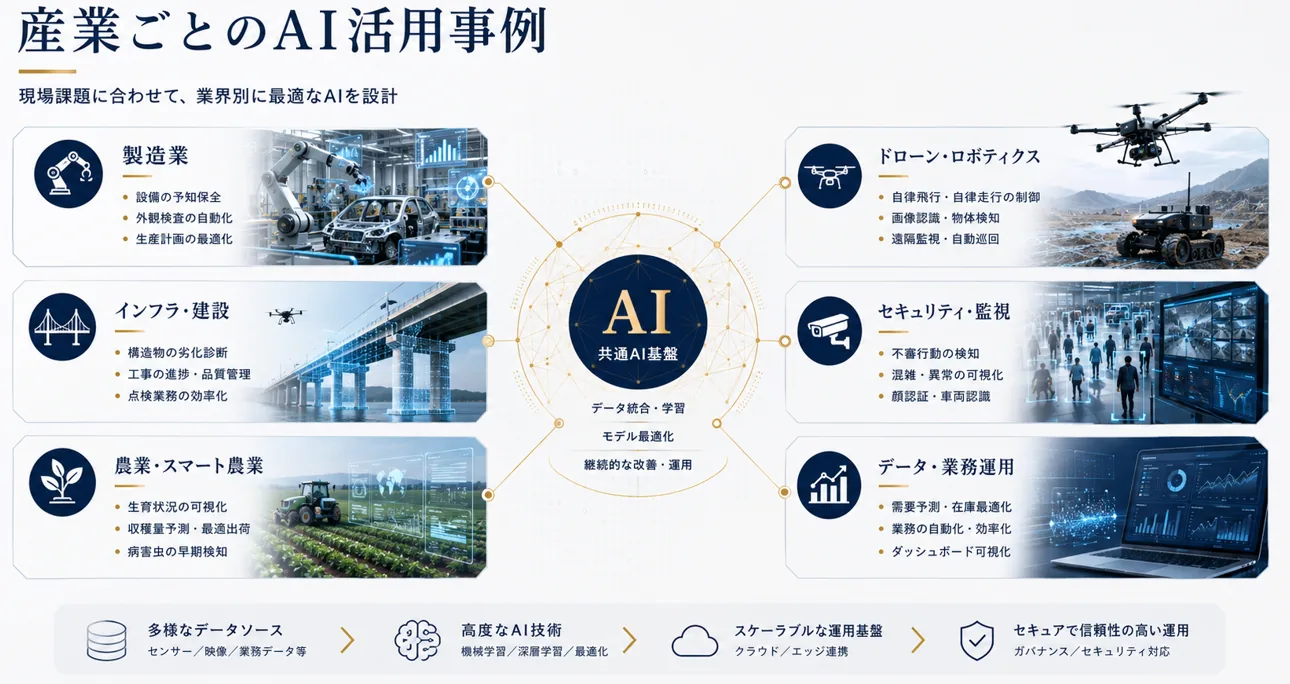
Image text translation
Reference translation prepared for this website. The source image is unchanged; this is not an original or certified translation.
AI use cases by industry
Designing suitable AI for each industry and its field challenges
Manufacturing
Infrastructure and construction
Agriculture and smart farming
Drones and robotics
Security and monitoring
Data and business operations
Shared AI infrastructure
The shared platform connects to six industry areas. The lower arrows connect data sources, AI technology, scalable infrastructure and secure operations. These are application examples, not project-specific accuracy or delivery guarantees.
If visual inspection rejects good products and fails to reduce reinspection, we evaluate missed defects and false positives separately. We define the causes to investigate and the evaluation scope across imaging, acceptance criteria, training data and reinspection workflows.
Check lighting, viewing angle, speed, variation between items and installation conditions.
Agree on acceptance criteria and borderline examples, then measure missed defects and false positives separately. If defect images are scarce, assess data bias and whether further data can be collected.
Evaluate not only accuracy, but reinspection volume and time, cycle time and operator review procedures. We do not promise improvements from a small image sample alone.
Stop criteria: if defect definitions cannot be aligned, essential features cannot be captured, or operational burdens outweigh benefits, decide whether further validation or a stop is appropriate.
Discuss the scope of a manufacturing PoCImaging and AI classification are evaluated separately from controls needed to operate equipment safely. Start with product selection or a narrowly defined evaluation, then assess whether collaborative R&D or an AI infrastructure deployment is needed.
Define process-specific evaluation plans, missed-defect and false-positive metrics, and operational constraints to support an adoption decision. Agree on evaluation items and deliverables for the process concerned.
We identify the evaluation and support scope from your use case, existing equipment and available data.
With an aging population and shortages of engineers and successors, manufacturers of all sizes need ways to pass on shop-floor knowledge. Saving work footage alone does not explain what an expert noticed, which change signaled a problem, or why they chose the next action.
Align equipment data, video, audio and work records on a shared timeline so the next generation can use the context behind a decision.
Identify decisions that depend on individuals and turn them into records and support procedures that experienced and junior staff can review together.
Use the inputs the task requires, such as cameras, sound, vibration and environmental sensors, to identify signs of abnormal conditions.
Check integration requirements for existing equipment and business systems, and share only the necessary information securely.
A large-scale replacement is not the starting assumption. For each operational challenge, identify whether to begin with data input, Edge AI, existing-equipment integration, or recording and learning.
Design image capture around lighting conditions and the inspected object, then connect it to image analysis with reviewable grounds for each decision.
Combine video and sensor data to flag potential anomalies for maintenance staff to review.
Link work records with expert explanations to create knowledge that supports training, review and standardization.
Design alerts, records and interfaces to reduce missed observations and checks, with people retaining final responsibility for decisions.
Process data locally and share only what is needed, according to confidentiality, connectivity and latency requirements.
Confirm the integration scope for existing PCs, cameras, sensors, APIs and databases on a project-by-project basis.
A PoC is not an AI showcase; it should provide evidence for a deployment decision. Define evaluation criteria, users, data handling and connections to existing equipment at the outset.
Published information alone does not establish universal claims about project results, performance, duration or cost. We make proposals after reviewing the target objects, equipment, data and operating conditions.
| Available services | Custom AI development, image analysis, camera and input evaluation, Edge AI configuration planning, and PoC design. |
|---|---|
| Integration under validation | Multi-sensor integration, connections between field edge systems and data infrastructure, and operational design incorporating continuous learning. |
| Future concepts | A distributed AI foundation that securely circulates knowledge and models across sites and accumulates improvements across industries. |
Before a PoC, define collection purposes, retention scope, access permissions, training use and IP ownership. Pre-filing inventions, customer-specific specifications and non-public data are not published on public pages.
Process information at the edge when it can be handled locally, and define sharing scope according to the purpose.
Review public IP, licensing, joint development and deliverable ownership alongside business design.
IPA's AI skill-transfer case studies, JILPT's research on AI in manufacturing and other publicly available primary sources inform our work.
Even before a complete dataset is available, we can define a starting point for a PoC from your operational challenges, users, existing equipment and confidentiality requirements.