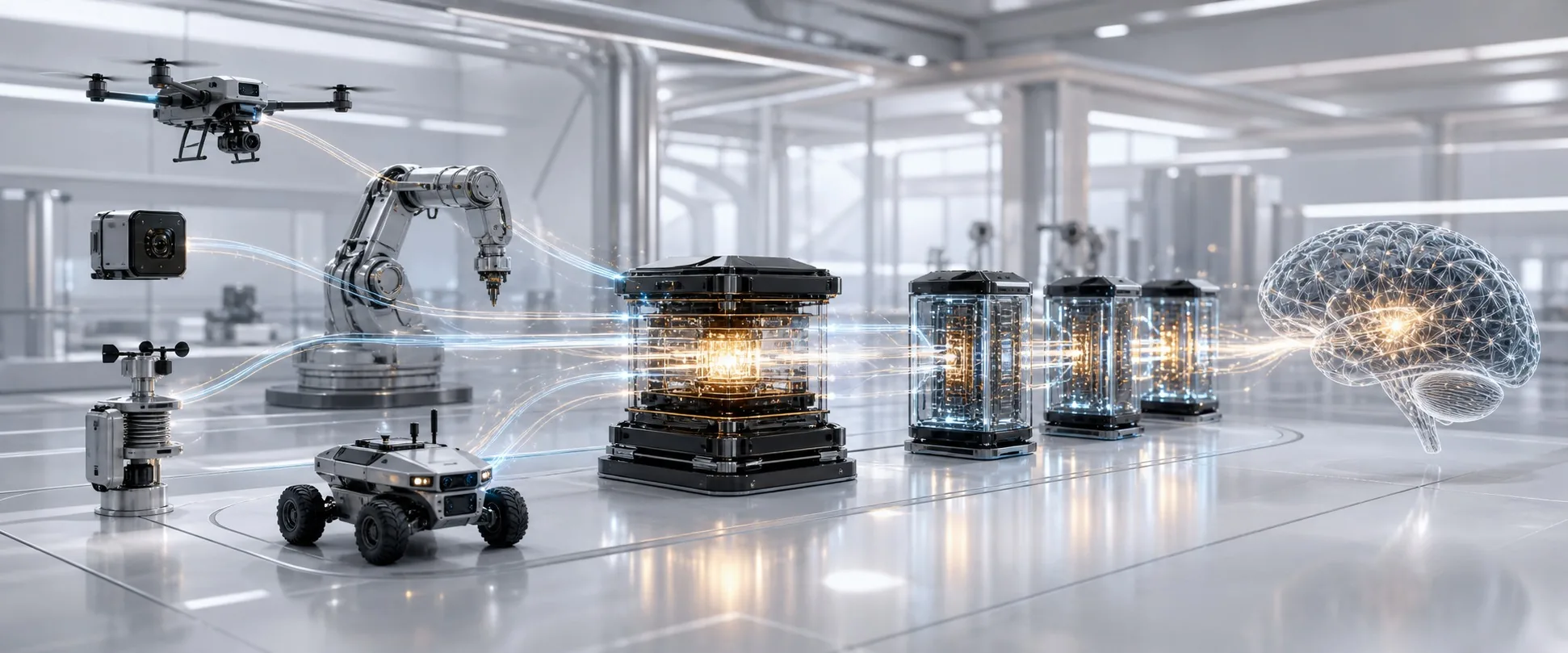
AI SOLUTIONS / DEVELOPMENT & DX
AI Solutions
From defining the challenge to design, development and deployment
From field data captured by cameras and sensors to generative AI and business agents. Our development team, backed by proprietary patents, works with you from PoC through operation.
Design AI around where your data may go.
For AI without external transmission of confidential information, we distinguish internal document search from factory-video inference. We confirm where source files, questions, answers and logs are processed and stored.
- Processing locations and transfer boundaries for source files, questions, answers and logs
- Communications during inference and maintenance, and operation during outages
- Retention, user permissions, training use and audit
- Whether field devices and existing servers meet the objective
Stopping criteria: if data rights, operational permissions or security requirements cannot be met, revise the configuration or stop the PoC.
Discuss edge inference for factory video Discuss confidential document search and local LLMsOptions include operation without transferring data outside the environment. Collection, learning and model distribution require customer agreement, permissions, defined purposes and safety checks. This does not mean automatic collection or unauthorized retraining.
Before connecting recognition directly to equipment control, we confirm communication outages, power and heat, human intervention, notifications and safe-stop responsibilities. Manufacturer statements and SLL hardware verification are distinguished.
- Who it is for
- Field operators, systems integrators, equipment companies and inspection-system developers.
- Topics to discuss
- Feasibility evaluation and implementation of visual inspection, night monitoring and closed-network AI. We isolate imaging, data, model, communications and operational issues.
- Deliverables after agreement
- Evaluation plans, data-boundary matrices, configuration proposals and comparison and limitation reports. Before measurement, these are plans, not results.
- Fit criteria
- Confirm data handling, processing locations and connected systems, then define evaluation items and scope.
- Next stage
- Focused reevaluation, prototyping and field deployment. New AI infrastructure is not assumed when existing equipment is sufficient.
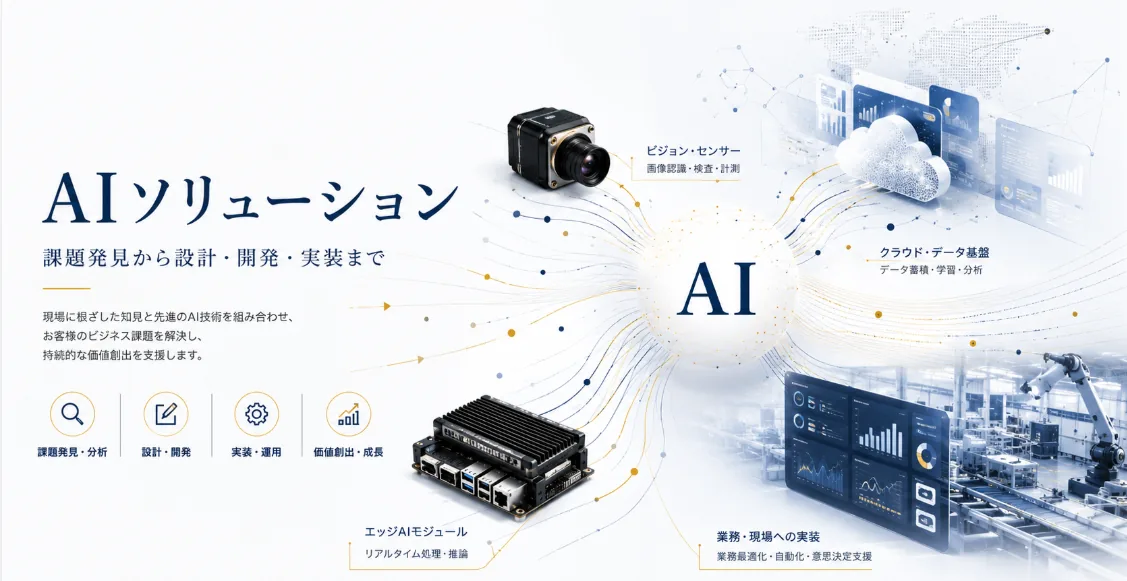
Image text translation
Reference translation prepared for this website. The source image is unchanged; this is not an original or certified translation.
AI solutions
From identifying challenges to design, development and implementation
We combine field-based expertise with advanced AI technologies to address customers' business challenges and support sustained value creation.
- Challenge identification and analysis / design and development / implementation and operations / value creation and growth
- Vision and sensors: image recognition, inspection and measurement
- Cloud and data infrastructure: data storage, learning and analysis
- Edge AI modules: real-time processing and inference
- Deployment into business operations and field environments: optimization, automation and decision support
Lines converge on AI at the center, connecting the camera / sensors, cloud / data infrastructure, Edge AI module and operational environment.
Our AI work builds on an established technology foundation.
We implement Physical AI, with design experience spanning AI eyes through color night vision to AI data centers. That foundation supports the AI development we undertake for your business.
Field data × AI
Our strength is building AI from first-hand field data, including cameras, sensors and video, rather than generic datasets alone. We work with demanding conditions such as night, low light and outdoor environments.
Patent-backed technology
Granted patents in image processing, surveillance systems and other fields support our AI development and Physical AI implementation.
Integration with international technology partners
Partnerships with the UK's Sky-Drones and Taiwan's APPRO and GEC extend the configurations we can develop beyond our own capabilities alone.
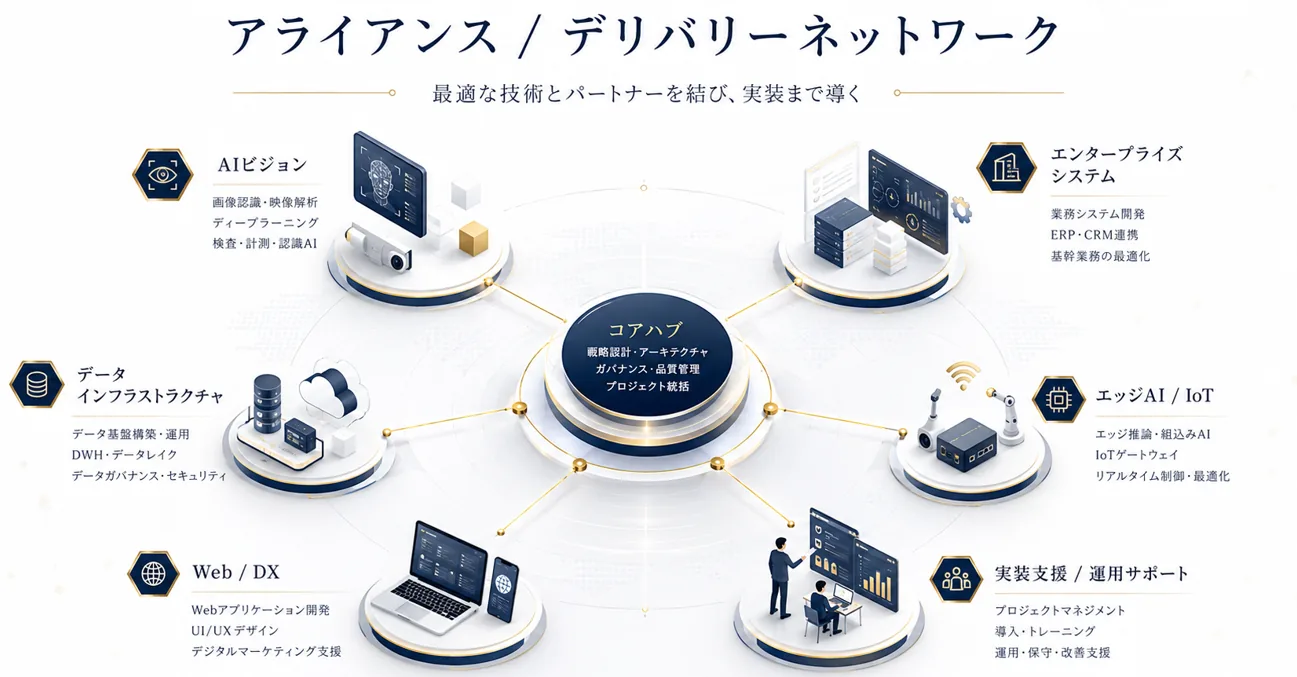
Image text translation
Reference translation prepared for this website. The source image is unchanged; this is not an original or certified translation.
Alliance / delivery network
Connecting suitable technologies and partners through to implementation
Core hub
- Strategy design and architecture / governance and quality management / project coordination
AI vision
- Image recognition and video analytics / deep learning / inspection, measurement and recognition AI
Enterprise systems
- Business-system development / ERP and CRM integration / core-business optimization
Data infrastructure
- Data-platform construction and operation / DWH and data lakes / data governance and security
Edge AI / IoT
- Edge inference and embedded AI / IoT gateways / real-time control and optimization
Web / digital transformation
- Web-application development / UI/UX design / digital-marketing support
Implementation assistance / operational support
- Project management / deployment and training / operations, maintenance and improvement support
The central hub connects to six surrounding capability domains; the diagram shows coordination, not an assertion that all work is performed by one entity without responsibility boundaries.
Software alone does not make field AI work.
AI adoption depends on imaging, communications and operational conditions as well as algorithms. We assess constraints such as low light, backlighting, outdoor exposure, bandwidth and restrictions on data transfer. SLL serves as the point of contact, defining the camera, AI and implementation responsibilities and their boundaries.
| Aspect | Software-focused AI development | Standard Link |
|---|---|---|
| Training data | Assumes customer-held data | Support begins with sensor selection, installation design and data acquisition |
| Low light and adverse conditions | Depends on existing camera performance | We supply color night vision. 0.0007 lux is a reference value under our evaluation conditions. |
| Responsibility boundaries | Separate teams for cameras, AI and system integration | SLL serves as the point of contact, defining the camera, AI and implementation responsibilities and their boundaries. |
| Data transfer | Often assumes cloud use | Designed around Edge AI, closed networks and on-premises environments |
| Intellectual property | Handled case by case | Proprietary patents and project deliverable rights design |
Comparison with general approaches, not a statement about any specific company.
Start even when there is no training data.
A frequent challenge in AI discussions is that data is missing or unusable. This can prevent projects from progressing.
We can start with imaging itself, designing which sensors to install, where and under what conditions to produce usable training data. If existing images are too dark to distinguish the subject, we can propose a revised camera configuration.
The same team can progress from no data to PoC, supported by our own camera offering.
Discuss a project before data is available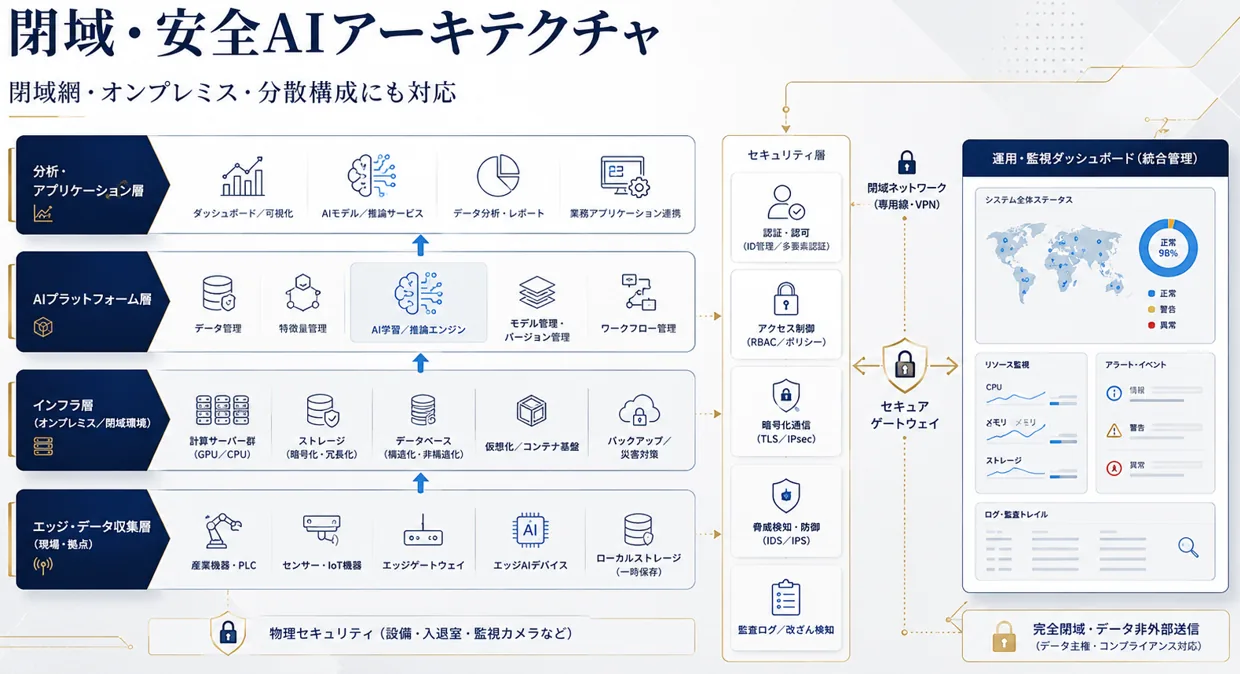
Image text translation
Reference translation prepared for this website. The source image is unchanged; this is not an original or certified translation.
Closed-network, secure AI architecture
Architecture for closed-network, on-premises and distributed configurations
Analytics and application layer
- Dashboards and visualization / AI models and inference services / data analysis and reports / business-application integration
AI platform layer
- Data management / feature management / AI training and inference engines / model and version management / workflow management
Infrastructure layer (on-premises / closed-network environment)
- Compute servers (GPU / CPU) / storage (encryption and redundancy) / databases (structured and unstructured) / virtualization and container infrastructure / backup and disaster recovery
Edge and data-collection layer (field sites and locations)
- Industrial equipment and PLCs / sensors and IoT devices / edge gateways / Edge AI devices / local storage (temporary retention)
Security layer
- Authentication and authorization (identity management / multi-factor authentication) / access control (RBAC / policies) / encrypted communication (TLS / IPsec) / threat detection and defense (IDS / IPS) / audit logs and tamper detection
- Closed network (dedicated line / VPN) / secure gateway
Operations and monitoring dashboard (integrated management)
- Overall system status: 98% normal; status categories: normal, warning and abnormal
- Resource monitoring: CPU / memory / storage
- Alerts and events: information / warning / abnormal; logs and audit trail
- Physical security: equipment, entry / exit control, surveillance cameras and related measures
- Source label: fully closed network, no external data transmission (data sovereignty and compliance)
Upward arrows lead from collection through infrastructure and the AI platform to applications. Side connections lead through the security layer and gateway to integrated monitoring. Physical security underpins the stack.
Site note: 98% is an illustrative dashboard value, not a measured service result. The closed-network and security labels describe a design concept; actual data flows, controls and operating conditions must be confirmed per project.
From field challenges to operational AI.
Development builds on the NVIDIA Jetson ecosystem, with integrated design from the edge to closed-network data infrastructure.
Image and video AI development
Visual inspection, anomaly detection, activity recognition and night or low-light video analysis, with low-latency processing at the edge.
Generative AI and secure RAG
Generative AI environments for secure use of internal documents and technical materials, including closed-network and on-premises configurations for organizations with data-transfer restrictions.
AI agents for business workflows
Implement routine work such as inquiries, reports and inspection records as AI agents, including integration with existing business systems.
DX and operational support
From reviewing workflows and identifying AI opportunities to PoC planning, deployment and ongoing operation, with support across field and technical requirements.
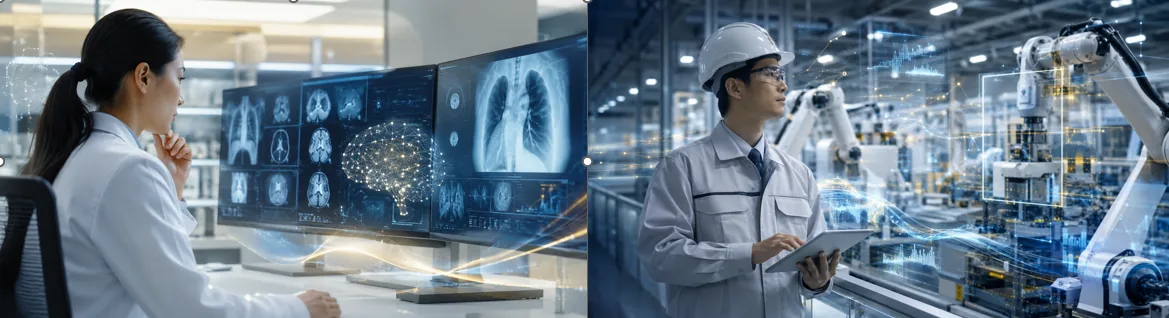
Services and deliverables
Configurations vary by project. Typical scopes are outlined below.
01 Image and video AI development
- Applications
- Visual inspection for scratches, missing parts and foreign objects; anomaly detection; activity recognition; detection and tracking of people, vehicles and vessels; night and low-light video analysis
- Approach
- Low-latency edge processing. We can participate from camera, lens and lighting design, and can also use existing camera assets.
- Engagement options
- PoC / full development / edge-device integration
- Typical deliverables
- Trained models, inference applications, accuracy evaluation reports and operating procedures
02 Generative AI and secure RAG
- Applications
- Internal document search, technical knowledge management, automated reports and meeting minutes, and drawing and form recognition
- Approach
- Closed-network and on-premises configurations. Models are selected for confidentiality, response time, cost and operating requirements, without a fixed vendor.
- Engagement options
- Environment setup / RAG pipeline development / operational design
- Typical deliverables
- RAG environments, document-processing pipelines, accuracy evaluation, and access and audit design
03 AI agents for business workflows
- Applications
- Initial inquiry responses, inspection records, report generation and integration between business systems
- Approach
- Connect to existing business systems and APIs, with human-in-the-loop review built into operations.
- Engagement options
- Workflow design / agent development / existing-system integration
- Typical deliverables
- Agents, integration interfaces, operational rules, and logging and audit design
04 DX and operational support
- Applications
- Workflow review, identification of AI opportunities, PoC planning, investment decision support and internal rollout
- Approach
- Design for changing how work gets done, not simply for installing AI.
- Engagement options
- Advisory support / PoC design / post-deployment improvement
- Typical deliverables
- Current-state analysis, application roadmap, PoC design and proposed operating structure
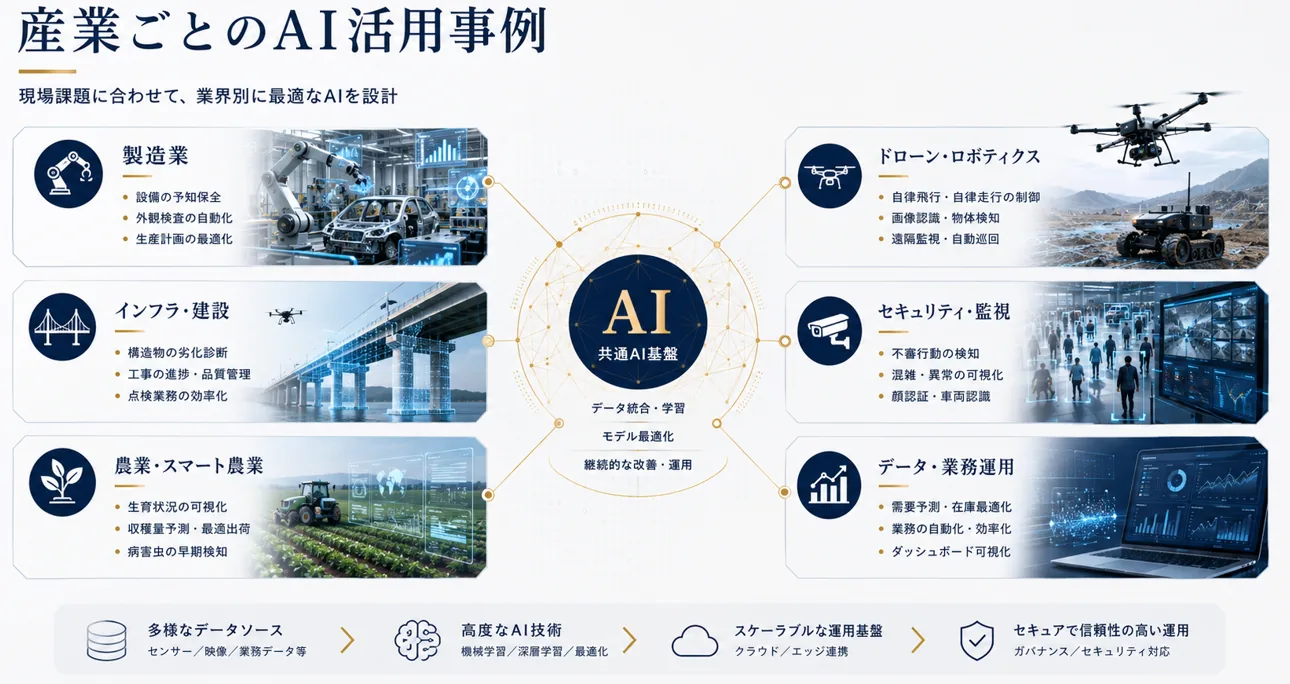
Image text translation
Reference translation prepared for this website. The source image is unchanged; this is not an original or certified translation.
AI use cases by industry
Designing suitable AI for each industry and its field challenges
Manufacturing
- Predictive equipment maintenance / visual-inspection automation / production-planning optimization
Infrastructure and construction
- Structural deterioration assessment / construction progress and quality management / inspection efficiency
Agriculture and smart farming
- Crop-growth visualization / yield forecasting and shipment optimization / early pest and disease detection
Drones and robotics
- Autonomous flight and driving control / image recognition and object detection / remote monitoring and automated patrols
Security and monitoring
- Suspicious-behavior detection / congestion and anomaly visualization / face authentication and vehicle recognition
Data and business operations
- Demand forecasting and inventory optimization / business automation and efficiency / dashboard visualization
Shared AI infrastructure
- Data integration and learning / model optimization / continuous improvement and operations
- Diverse data sources: sensors, video, business data and others
- Advanced AI technology: machine learning / deep learning / optimization
- Scalable operational infrastructure: cloud / edge integration
- Secure, reliable operations: governance and security measures
The shared platform connects to six industry areas. The lower arrows connect data sources, AI technology, scalable infrastructure and secure operations. These are application examples, not project-specific accuracy or delivery guarantees.
USE CASES: AI for the field
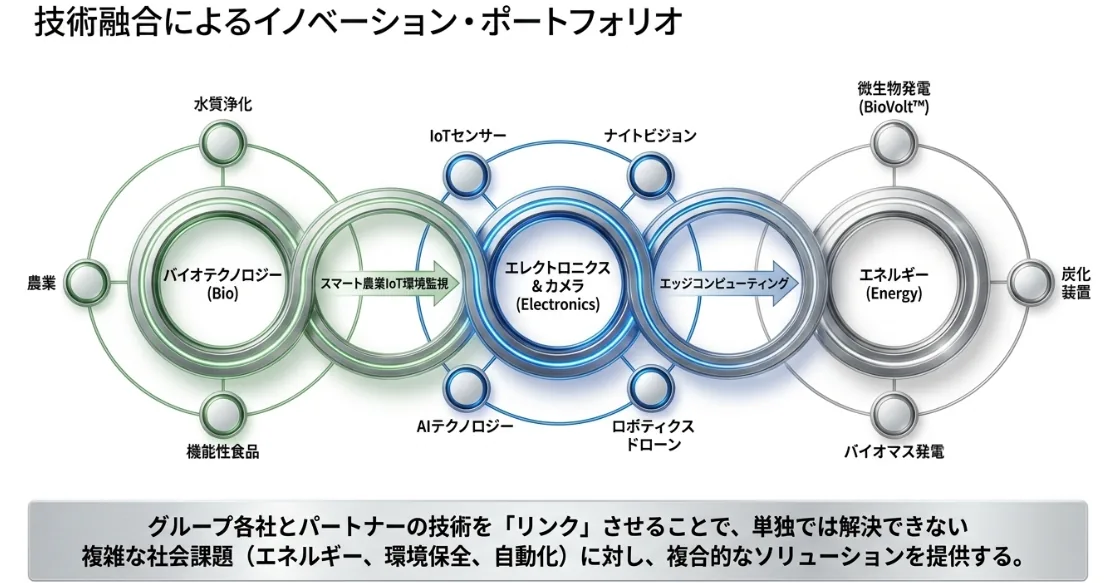
Image text translation
Reference translation prepared for this website. The source image is unchanged; this is not an original or certified translation.
An innovation portfolio built through technology integration
Biotechnology (Bio)
- Water purification / agriculture / functional foods
Electronics and cameras
- IoT sensors / night vision / AI technology / robotics and drones
Energy
- Microbial power generation (BioVolt™) / carbonization equipment / biomass power generation
The linked rings run from Bio through smart agriculture / IoT environmental monitoring to Electronics, then through edge computing to Energy.
By linking technologies from group companies and partners, the concept provides combined solutions to complex social challenges in energy, environmental conservation and automation that cannot be resolved by one technology alone.
Visual inspection AI: assess imaging conditions, including low light
We review subjects, lighting, motion and acceptance criteria individually, defining image-quality requirements and evaluation methods. Camera and Edge AI configurations are considered against reflections, shadows and illumination changes in the field.
HOLONIC Eyes is an imaging option evaluated through PoC with actual subjects and conditions. 0.0007 lux is a low-light imaging reference under our evaluation conditions; it does not guarantee AI inspection accuracy or eliminate the need for lighting.
Explore HOLONIC Eyes
Night and wide-area monitoring AI
Color night vision, millimeter-wave sensing and Edge AI are combined to identify what is happening and where in darkness and adverse weather. For infrastructure, ports, airports and large sites, we design closed-network paths from detection to notification to support more efficient security operations.
Explore sensing technologies
Generative AI and agents in closed networks
We design generative AI around the requirement that data cannot enter external clouds. Generative AI and agents operate within domestic closed-network environments, spanning the edge and data centers, supporting document search, form recognition and workflow automation while keeping confidential data under your control.
Explore technology and IP
Customer harassment and harassment response
AI helps organize objective records of face-to-face incidents for review and sharing. We offer separate entry points for patented technology and contract development.
Explore AI that protects peopleExample configurations
Three illustrative configurations for common inquiry scenarios.
Example 1: visual inspection in low light
- Challenge
- Black, glossy parts reflect under lighting, yet their shape becomes difficult to distinguish when lighting is reduced.
- Configuration
- HOLONIC Eyes ultra-low-light color capture → Edge AI assessment → output to existing equipment
- Key point
- Minimize additional lighting and complete decisions on site, without transferring video outside.
Example 2: night monitoring of large sites
- Challenge
- Movement is detected at night, but distinguishing people from animals requires manual checks.
- Configuration
- Color night vision + millimeter-wave sensing → Edge AI detection and classification → notification to a management device within the closed network
- Key point
- Detection-to-notification paths can be configured without using external networks.
Example 3: internal knowledge AI in a closed network
- Challenge
- Design drawings and technical documents need to be used, but cannot be transferred to external clouds.
- Configuration
- Closed-network or on-premises RAG → access-controlled internal search and summarization → potential future consolidation into company AI infrastructure
- Key point
- Contracts define storage locations, permitted training use and access rights.
These are illustrative configurations based on inquiry scenarios, not claims of specific deployments.
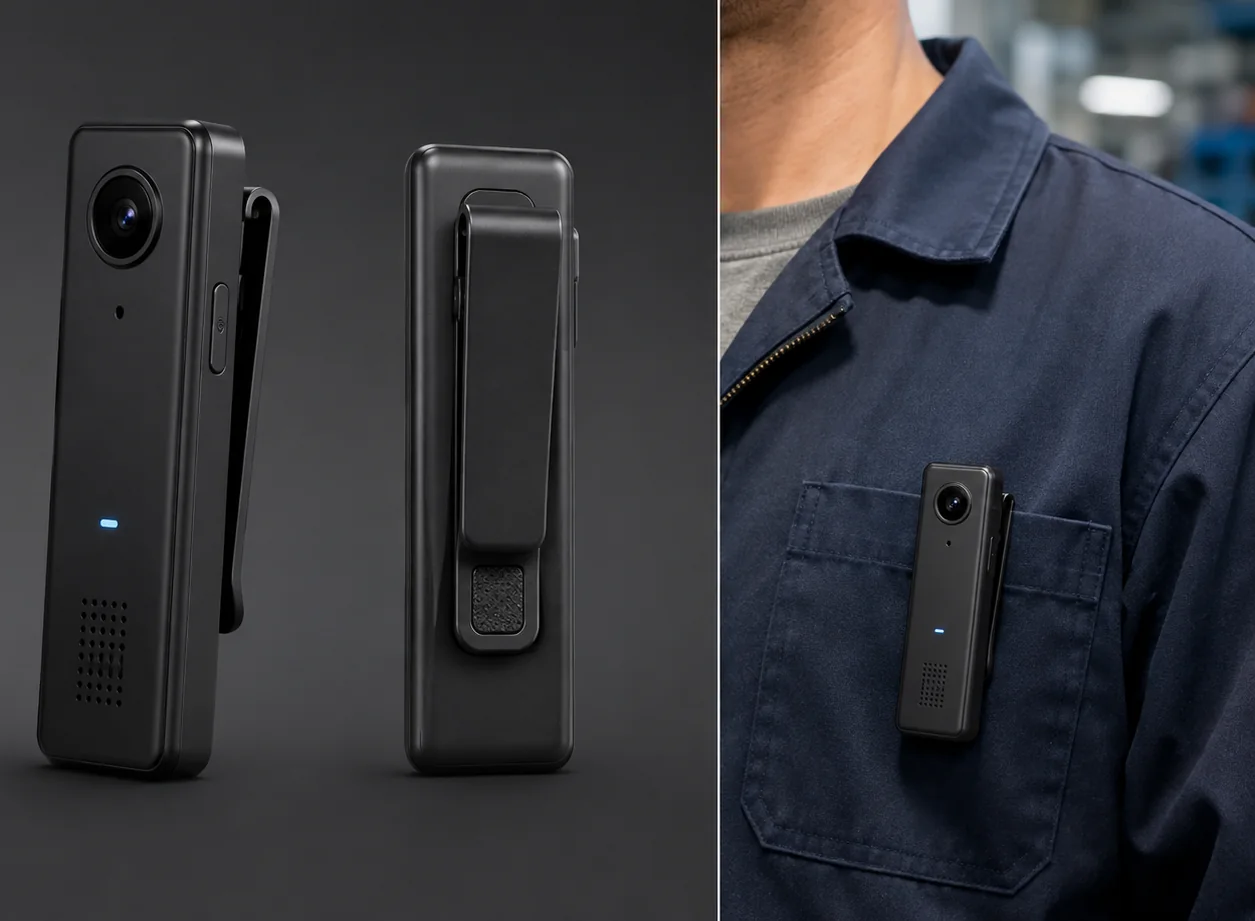
07 / PATENTED TECHNOLOGY
Japanese Patent No. 7728631
AI that protects people: harassment detection and recording technology
Publicly disclosed harassment-detection and recording technology supports fact-finding by people and organizations. In Japan, preventive measures against customer harassment become mandatory for all employers on October 1, 2026. We welcome co-creation partners for licensing, joint development and PoC.
Fixed-camera and general video-analysis inquiries are handled as AI contract development on this page, not as descriptions of this patent's scope.
Explore the patented technologyBring AI into real operations.
Manufacturing
Inspection and predictive maintenance
Security
Night and wide-area monitoring
Municipalities and disaster preparedness
River, road and infrastructure monitoring
Agriculture and environment
Growth, water quality and soil
Logistics and ports
Vehicles, vessels and cargo
Services and facilities
AI for field workflows
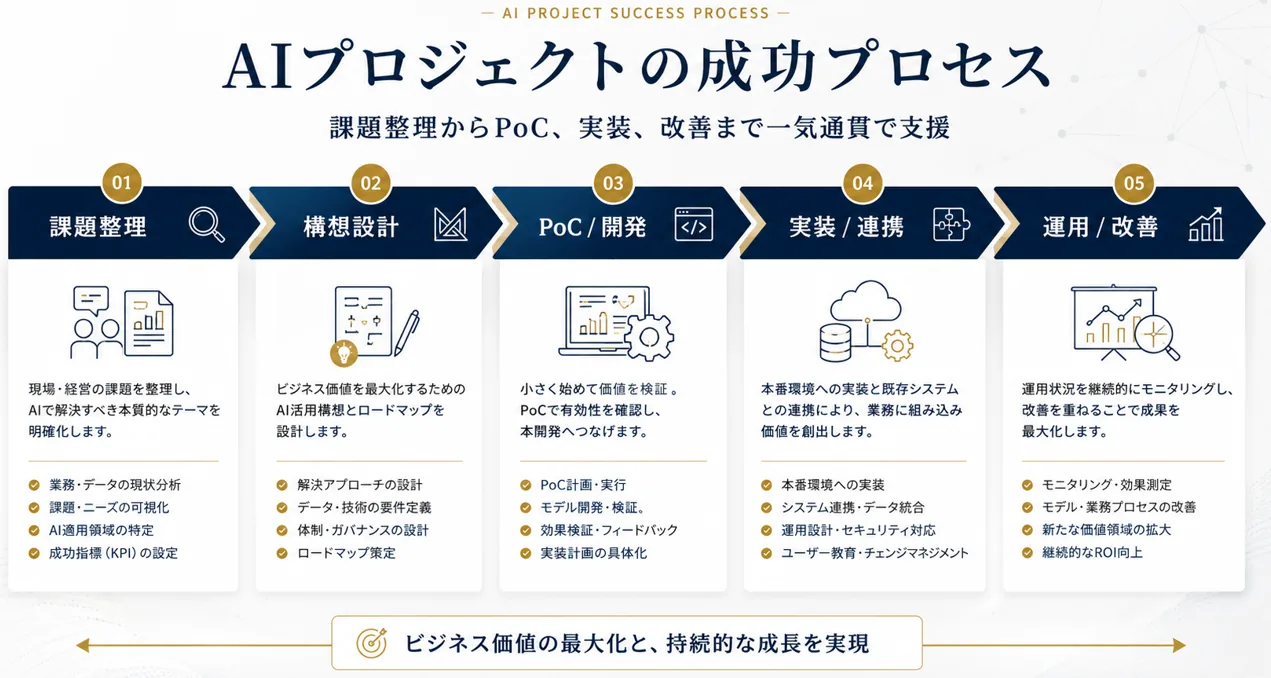
Image text translation
Reference translation prepared for this website. The source image is unchanged; this is not an original or certified translation.
AI project success process
Support from clarifying challenges through PoC, implementation and improvement
01 Clarify challenges
Organize operational and management challenges and identify the essential issues AI should address.
- Analyze current operations and data / visualize challenges and needs / identify AI application areas / define success indicators (KPIs)
02 Concept design
Design an AI adoption concept and roadmap aimed at maximizing business value.
- Design the solution approach / define data and technical requirements / design the team and governance / establish a roadmap
03 PoC / development
Start small and test value. Verify effectiveness through a PoC before moving into full development.
- Plan and execute the PoC / develop and validate models / evaluate effects and feedback / detail the implementation plan
04 Implementation / integration
Integrate into operations through production deployment and existing-system integration to create value.
- Production deployment / system and data integration / operational design and security / user training and change management
05 Operations / improvement
Continuously monitor operations and iterate improvements to maximize outcomes.
- Monitoring and impact measurement / model and business-process improvement / expansion into new value areas / ongoing ROI improvement
The intended outcome is greater business value and sustained growth.
Arrows connect stages 01–05 from left to right; the lower two-way line spans the process and labels its intended business outcome.
Validate on a small scale, then expand into the field.
- 01
Initial discussion
We discuss the challenge and field conditions. NDAs are available.
- 02
PoC
Assess results through small-scale validation. An indicative duration is 4–8 weeks.
- 03
Development and deployment
Build the production system and deploy it in the field.
- 04
Operation and improvement
Support accuracy improvement, retraining and ongoing operation.
Timing and costs depend on project conditions. Durations are indicative, not guaranteed.
How we assess cost and timing
Estimates cover requirements, data preparation, model development, field implementation and operational support. Five factors materially affect cost.
- Availability and volume of training data
- Field conditions: illumination, installation and communications
- Scope of integration with existing systems
- Closed-network and on-premises requirements
- Required accuracy and number of validation rounds
Where technical or operational conditions are unconfirmed, a PoC measures value and difficulty to support the development investment decision. Products with clear conditions can proceed through evaluation and adoption. Scope determines timing and cost; initial discussions establish the approach and estimation basis.
Timing and costs vary by project. Stated durations are indicative, not guaranteed.
Handling confidential information
- We can enter into an NDA from the discussion stage.
- Contracts define storage location, training permissions, access rights and retention periods.
- Closed-network and on-premises designs can keep data within the environment.
- Projects potentially subject to export controls or involving sensitive technology are handled under applicable laws and internal rules.
Supported by technology, IP and partners.
A development company with proprietary patents
Standard Link holds 5 granted patents across image processing, surveillance systems and other fields (Details: company IP & RESEARCH)。
Source: J-PlatPat.Global technology partners
Sky-Drones and APPRO: exclusive distribution rights in Japan. GEC: strategic partnership. Integration builds on publicly announced relationships.
Group development structure
Joint development with our group company in drones and aircraft, and AES Lab in environmental and microbial technologies.
Development teams and technology foundation
- Development structure: We undertake development from requirements through implementation and operation. Depending on project scale and scope, we form teams with development partners in Japan, supporting highly confidential projects and requirements to keep data within Japan.
- Edge infrastructure: Built around the NVIDIA Jetson ecosystem, including Jetson Orin NX, with Intel Edge configurations also supported.
- Visual input: Our HOLONIC Eyes and APPRO camera modules, for which we hold Japanese distribution rights, are configured for each application.
- Generative AI: Models are selected for confidentiality, response time, cost and operating environment without a fixed vendor. Closed-network and on-premises configurations are supported.
- Group structure: We work with our group company in unmanned aircraft and AES Lab in environmental and microbial technologies to develop systems beyond software alone.
- Intellectual property: We hold 5 granted patents across image processing, surveillance systems and other fields. Source: J-PlatPat.
Frequently asked questions.
Can we discuss a small project?
Yes, including small PoC evaluations. We define the scale in the initial discussion.
Our data cannot leave the company. What are the options?
We first distinguish document search from video inference, then confirm processing locations, retention, permissions and training use for source files, questions, answers and logs. Closed networks define communication boundaries; on-premises describes installation and operation; dedicated clouds are isolated cloud environments. These are not interchangeable. We consider a configuration that meets your requirements.
Can you integrate with existing systems?
We design around connections to existing business systems, cameras and sensors.
Who owns the developed AI?
Ownership is defined by contract. Deliverables, training data, models and existing IP are addressed for each project.
Can we discuss defense or security-related projects?
We assess the permissible scope individually. Export controls and sensitive technologies are handled under applicable laws and internal rules.
Can we engage you without training data?
Yes, starting with data acquisition conditions and existing equipment. The manufacturing AI page addresses limited defect images and false positives through imaging, acceptance criteria and reinspection workflows. We confirm usable data and evaluation scope; results are not universally guaranteed.
Explore visual inspection and manufacturing AI evaluationCan you provide cameras and hardware as well?
Yes. We supply color night vision cameras and can provide configurations including Edge AI devices. Software-only engagements are also available.
Which AI models or LLMs do you use?
Models are chosen for confidentiality, response speed, cost and operating requirements, without a fixed vendor. Configurations can also operate in closed networks or on premises.
Can a system operate without the cloud?
With Edge AI or local LLMs as candidates, we check device processing capacity and memory, response times, storage, permissions, and communications during inference and maintenance. Outage operation is defined, and new AIDC is not assumed where existing equipment is sufficient.
What deliverables will we receive?
Depending on the project, deliverables include trained models, inference applications, accuracy reports and operating procedures. Deliverables and rights are defined in the contract.
Can you take over AI developed by another company?
Please discuss it with us. We review the current configuration and issues before defining the handover scope.
What should we prepare before contacting you?
Initially, provide a non-confidential overview of the challenge, workflow, existing equipment and decision you need to make. Before an NDA, do not send confidential photos, videos or drawings, third-party personal information or unpublished inventions. Detailed materials are handled only after permissions and handling conditions are confirmed.
Can government agencies or municipalities contact you?
Yes. We address public-sector challenges such as closed-network generative AI, night and wide-area monitoring, and infrastructure inspection. We can also provide estimates and technical materials in line with procurement requirements.
Can we discuss AI for customer-harassment prevention?
Yes. In light of Japan's customer-harassment prevention requirements taking effect on October 1, 2026, we discuss publicly disclosed patented technology and systems for objective incident records and sharing using existing cameras and audio. See AI that Protects People for details. This regulatory change applies in Japan.
BUILD WITH STANDARD LINK
Start by telling us about the challenge.
We review field conditions, available data and existing systems to define the first evaluation together.