Capture the required features
PHYSICAL AI PLATFORM
VERTICALLY INTEGRATED / RESEARCH / IP / DEPLOYMENT
Vertically Integrated Physical AI:from collaborative R&D to real-world deployment.
Connect AI cameras and sensors, Edge AI, drones and robots, distributed AI nodes and AIDC through one design.
From collaborative R&D to PoC, IP, product development and deployment in Japan and worldwide.
Bringing Japanese manufacturing to global standards with AI.
Discuss a Physical AI PoC
Discuss collaborative R&D and commercialization
Explore the integrated architecture
PRODUCT / Explore HE-1 capabilities
Design Physical AI as a field decision loop.
Cameras, sensors, Edge AI, drones, robots, distributed AI nodes and AIDC are connected into one operational design, only to the extent required.
Recognize, select and decide in the field
Connect to notifications and actions
Optional branch: evaluation, storage and improvement
We consider existing servers, cloud services or small AIDC as appropriate, returning approved models to the field. A closed-network configuration can keep data within the environment.
RESEARCH & ENGINEERING
Problem definition, measurement, comparison and implementation decisions across the system
Solid lines show project-specific connections; the dashed box is an optional evaluation and improvement path. This is not a completed integrated installation. If Edge AI or existing servers meet the objective, AIDC is not required.
Discuss a Physical AI PoCOptions include operation without transferring data outside the environment. Collection, learning and model distribution require customer agreement, permissions, defined purposes and safety checks. This does not mean automatic collection or unauthorized retraining.
Image recognition and safe automated control are separate requirements. Notification recipients, human intervention, loss-of-communication behavior and stopping conditions are designed individually.
We design the whole system. Customers start where they need, whether adopting a camera, integrating existing equipment or pursuing collaborative R&D.
WHAT WE ARE
Physical AI understands the real world, makes decisions, acts and keeps learning.
Cameras and sensors perceive the world; Edge AI makes decisions in the field. Those decisions connect to drones, robots, vehicles and industrial equipment. Where needed, distributed AI infrastructure and AIDC store data and support learning, returning improved AI to the field.
Standard Link is a Vertically Integrated Physical AI company, designing eyes, brains, bodies, distributed processing and memory as one framework. Collaborative R&D, PoC, IP, product development, operation and commercialization in Japan and abroad turn that integration into real projects.
- 01 / WHAT WE ARE
- Vertically Integrated Physical AI company
- 02 / WHAT WE INTEGRATE
- AI eyes, brains, bodies, distributed processing and memory
- 03 / HOW WE WORK
- Collaborative R&D, PoC, IP, product development, operation and global commercialization
- 04 / HOW CUSTOMERS ENTER
- AI cameras, Edge AI, drones, AIDC and challenge-led discussions
PHYSICAL AI ARCHITECTURE
See. Sense. Think. Act. Learn.Build AI's whole body as one system.
Software alone cannot make AI operate in the real world. We design across sensor-input quality, local Edge AI decisions, communications and equipment actions, extending to data storage and retraining where needed. Not every project requires every layer.
We bring together proprietary technology, group companies, strategic partnerships, exclusive distribution rights and expertise from Japan and abroad under one design responsibility, integrating hardware and software.
- 01 / SEEAI EYE
Cameras
Turn the real world into image data
- 02 / SENSESENSOR LAYER
Diverse sensors
Sense environmental conditions and states
- 03 / DECIDEAI BRAIN
Edge AI and sensor fusion
Recognize, select and decide in the field
- 04 / ACTAI BODY
Drones, robots, vehicles and industrial equipment
Turn decisions into real-world actions
- 05 / CONNECTAI NERVOUS SYSTEM
Closed networks and distributed AI nodes
Process securely in the field and across sites
- 06 / LEARNAI MEMORY
HOLONIC DATA CENTER / Modular AIDC
Store, retrain and distribute models
Return improved AI to the field
Field data and operational knowledge feed learning and improvement, informing the next decisions and actions.
ACROSS EVERY LAYERRESEARCH / IP / SOCIAL IMPLEMENTATION
- Connect technologies through collaborative R&D
- Validate feasibility through PoC
- Protect the business through IP
- Deploy as products and operations
START WITH THE FIELD ISSUE
Start with your challenge, even before choosing the technology.
We review field conditions, available data, installation environment and business objectives to define the technologies and next steps required.
AI cannot recognize what it needs to see at night
Low-light imaging, night monitoring, ports, factories, equipment and mobile platforms. Start with cameras and HOLONIC Eyes to assess an on-site PoC.
Video or confidential data cannot leave your network
Closed networks, on-premises AI, Private AI and local inference. Design starts with where data resides and where it is processed.
Bring AI computing to your factory or research site
Small AI data centers, GPU infrastructure, phased deployment and distributed placement. Start at a scale suited to the use case and installation conditions.
Turn research concepts into collaborative R&D and business
We align industry-academia collaboration, PoC, IP, product development and assessment of public R&D funding eligibility along one commercialization path.
Start AI adoption on a small scale
Consider evaluation, PoC, Edge AI, local LLMs or small AIDC to define an initial configuration proportionate to the objective.
Give drones and robots eyes and a brain
AI cameras, Edge AI and autonomous or remote operation. We jointly develop configurations that let mobile systems perceive the field and make decisions.
AI for manufacturing and factories
Assess visual inspection, equipment monitoring, skills transfer, closed-network AI and field-data use through PoC, aligned with existing equipment and operations.
PHYSICAL AI STACK
Four business areas forming Vertically Integrated Physical AI
We do more than sell four technologies separately. According to the challenge, AI eyes, brains, bodies and memory are designed as one system.
Read the full image translation beside the larger image below
01 / AI EYE
AI cameras and sensing
Starting with color night vision and AI cameras, we turn images and diverse sensor signals into high-quality AI input for understanding the field.
AI cameras / AI image analysis / night vision / night monitoring / sensing Explore camera technology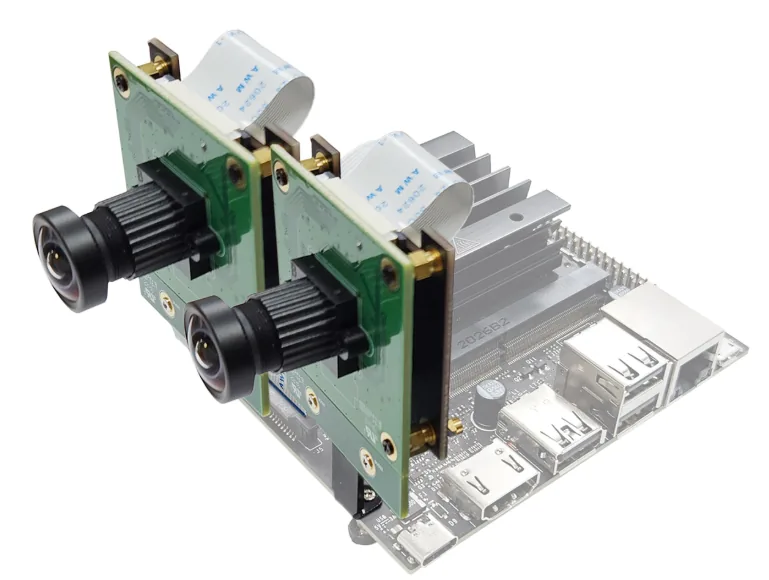
02 / AI BRAIN
Edge AI & Private AI
We jointly develop AI infrastructure for recognition and decisions in the field or closed networks, configuring VIA ARTiGO A5000, NVIDIA Jetson, local LLMs and generative AI as appropriate. We assess the path from PoC to operation in stages, considering latency and communications traffic.
Edge AI / on-premises AI / Private AI / closed-network AI / local LLMs Discuss an Edge AI PoC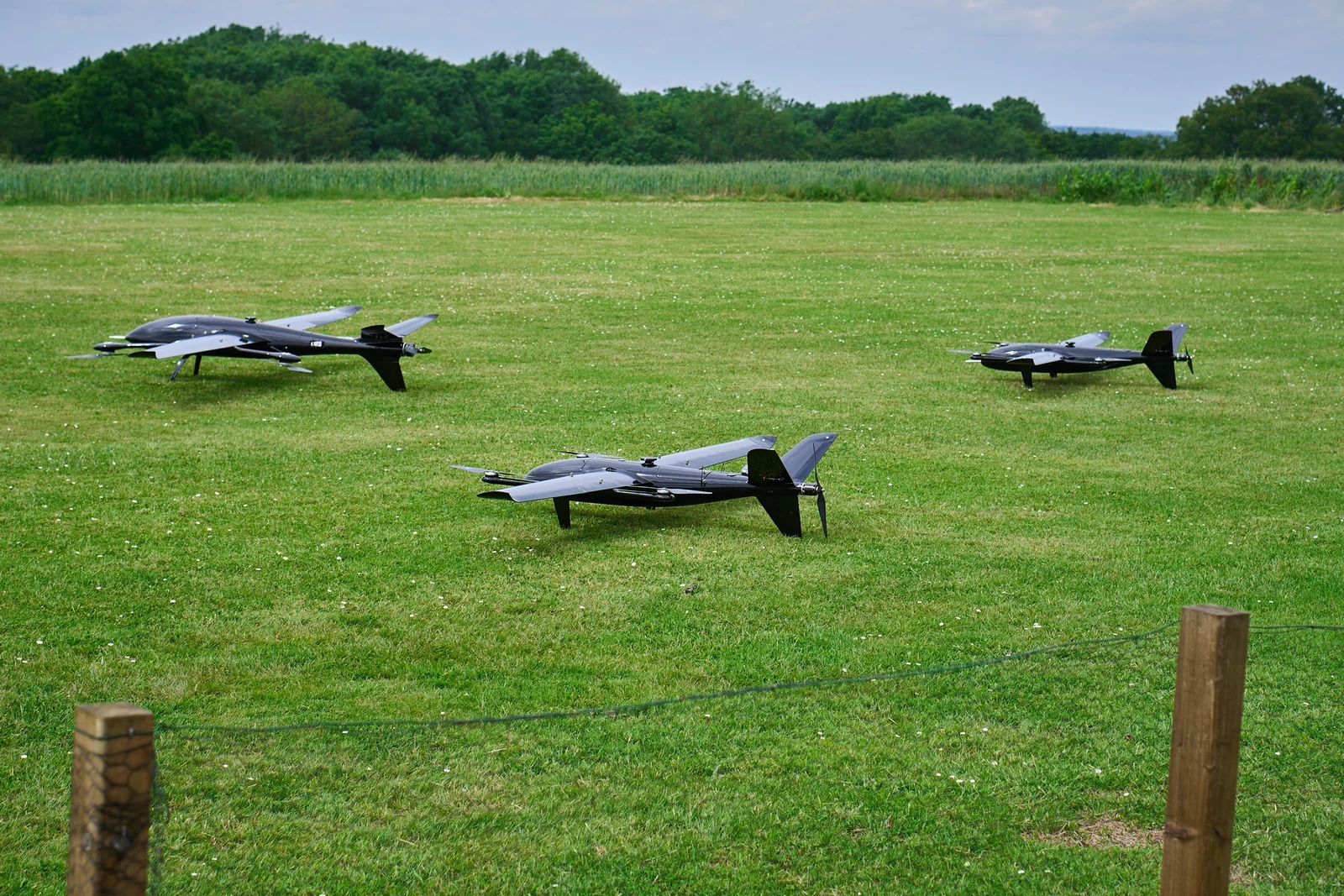
03 / AI BODY
Industrial drones and autonomous systems
We integrate AI cameras and Edge AI into drones and robots, jointly developing perception and decision-making for remote and autonomous operations.
Drone AI / autonomous flight / robot AI / remote monitoring Explore drone technology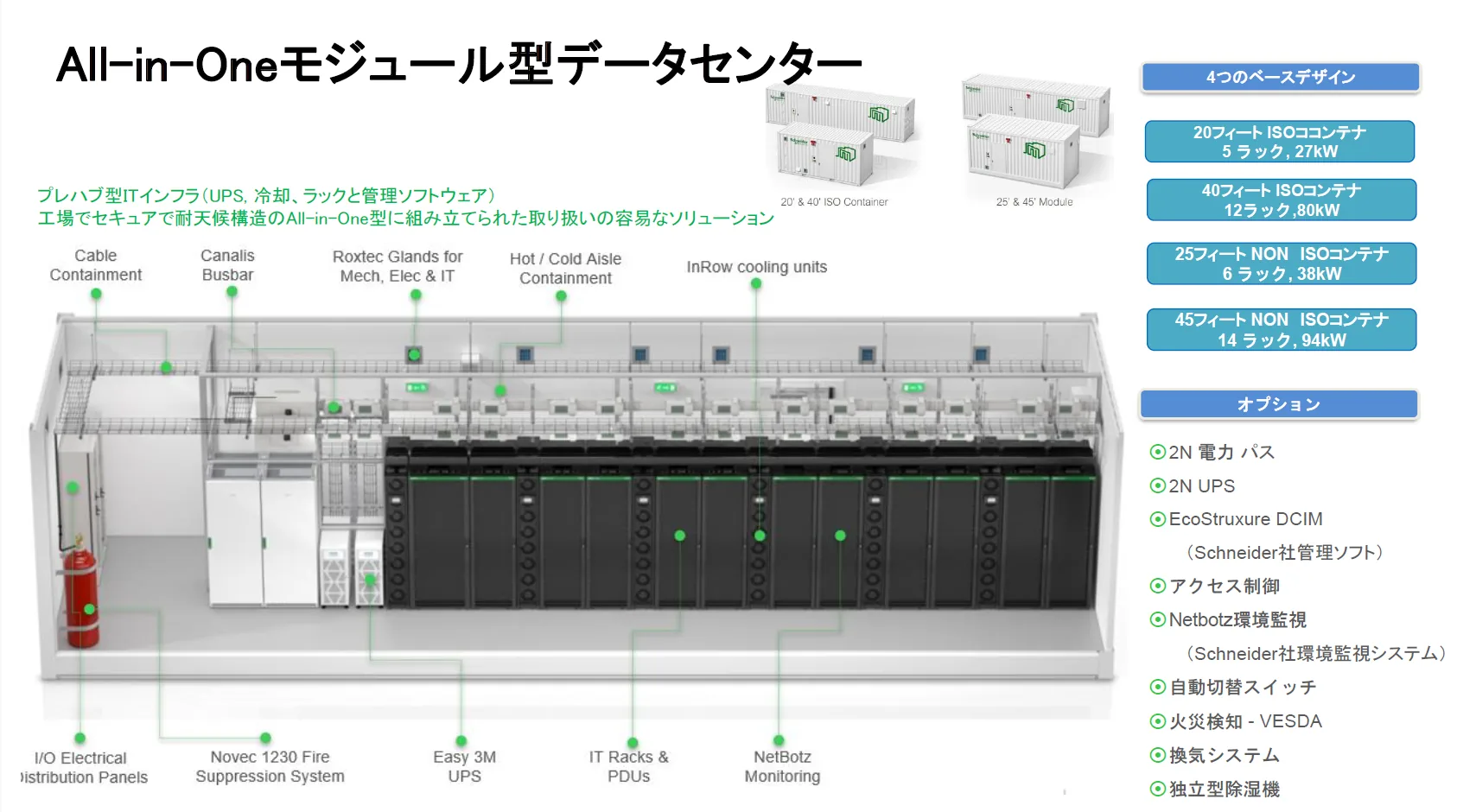
Read the full image translation beside the larger image below
04 / AI MEMORY
AI data centers and distributed AI infrastructure
We assess AI computing infrastructure close to research sites, factories, municipalities or closed-network environments, beginning with small configurations and expanding in stages.
Small AI data centers / modular AIDC / GPU infrastructure / distributed AI infrastructure Explore AIDC configurationsAIDC is not a prerequisite for every project. Depending on the field objective, Edge AI or local LLMs may be sufficient.
RESEARCH, IP & SOCIAL IMPLEMENTATION
Go beyond research and deployment to grow a business.
We assemble companies, universities, experts and technology partners for each project, progressing from collaborative R&D through PoC, IP and product development. Depending on the theme and team, we also explore links to public R&D programs and industry-academia-government collaboration.
Discuss a collaborative R&D theme- 01ChallengeConfirm field and business objectives
- 02Research themeInitial technical and market assessment
- 03Collaborative R&DConnect expertise and implementation teams
- 04PoCPrototype and validate feasibility
- 05IPDefine markets, data and implementation rights
- 06Product developmentDefine operational conditions
- 07Real-world deploymentExpand into business in Japan and abroad
SMALL START / MODULAR GROWTH
AI data centers, starting with a 5-rack, 27 kW configuration.
Rather than assuming a large installation from the outset, begin with a small research, PoC or enterprise AI configuration, then expand as results, usage and installation conditions are confirmed.
- CONTAINER
- 20 feet
- RACKS
- 5 racks
- REFERENCE
- 27 kW configuration
UPS, cooling, racks, monitoring and management are considered together for use cases such as research facilities, factories, municipalities, closed networks and PoC sites.
Configuration, the definition of the power rating, GPU, cooling, installation, lead time and maintenance conditions are confirmed for each project.
Image text translation
Reference translation prepared for this website. The source image is unchanged; this is not an original or certified translation.
All-in-One Modular Data Center
Prefabricated IT infrastructure: UPS, cooling, racks and management software.
A manageable all-in-one solution assembled at the factory in a secure, weather-resistant structure.
- Enclosure formats: 20-foot and 40-foot ISO containers; 25-foot and 45-foot modules.
Four base configurations
- 20-foot ISO container: 5 racks / 27 kW.
- 40-foot ISO container: 12 racks / 80 kW.
- 25-foot non-ISO container: 6 racks / 38 kW.
- 45-foot non-ISO container: 14 racks / 94 kW.
Equipment labels in the cutaway
- Cable containment
- Canalis busbar
- Roxtec seals for mechanical, electrical and IT penetrations
- Hot-aisle / cold-aisle containment
- InRow cooling units
- I/O electrical distribution panels
- Novec 1230 fire suppression system
- Easy 3M UPS
- IT racks and power distribution units (PDUs)
- NetBotz monitoring
Options
- 2N power paths
- 2N UPS
- EcoStruxure DCIM (Schneider management software)
- Access control
- NetBotz environmental monitoring (Schneider environmental monitoring system)
- Automatic transfer switch
- Fire detection: VESDA
- Ventilation system
- Standalone dehumidifier
How to read the diagram: leader lines connect the equipment labels to their locations inside the central container cutaway. The four base configurations and optional equipment are listed separately on the right.
Site note, not part of the source image: the power figures are configuration labels. Their definition, GPU configuration, cooling method, installation, delivery and maintenance conditions require project-specific confirmation; no IT-load, input-power or contracted-power definition is inferred here.
EDGE-TO-CORE AI
From field decisions to site-level learning and model updates.
- 01 / INPUTCamera / Sensor / FactoryCapture field data
- 02 / EDGEEdge AIRecognize and decide locally
- 03 / SMALL AIDC5 racks / 27kWStore and process nearby
- 04 / REGIONALRegional AIShare required information between sites
- 05 / CORECore AI Data CenterLearning and integrated management
- 06 / RETURNModel UpdateReturn improved AI to the field
Scope is designed around the use case, data volume and closed-network requirements. AIDC or a core AI data center is not assumed for every project.
RESEARCH & EXPERT NETWORK
Bring PhD-level experts, researchers and engineers into R&D.
We connect project-specific expertise in AI, vision, mathematics and data science, advanced manufacturing, environment and agriculture, energy, law and IP, and international affairs and security. Beyond advice, we work with companies, universities, research institutes and technology partners from research design through PoC, IP, product development and deployment.
We are building a framework to address R&D and deployment challenges faced by businesses, universities, research institutes, municipalities and communities. Individual collaboration and participation require agreement among the parties concerned.
- Who it is for
- Companies with research concepts, research institutes and businesses considering field trials.
- Topics to discuss
- Research themes, measurement and evaluation methods, research-data handling, responsibilities and implementation conditions.
- Deliverables after agreement
- Research plans, data-handling schedules and responsibility matrices. Specific deliverables and scope are confirmed by contract.
- Fit criteria
- Discuss the approach based on your research theme and intended use of results. Research participation, implementation, supply and maintenance responsibilities are agreed individually.
- Next stage
- Consider conditions for collaborative R&D, limited field trials, PoC and product development.
STANDARD LINKRESEARCH & DEVELOPMENT
- 01AI / VisionAI and vision
- 02Data ScienceMathematics and data science
- 03Advanced ManufacturingAdvanced manufacturing and production engineering
- 04Environment / AgricultureAgriculture, environment and marine science
- 05Energy / AIDCEnergy and AI infrastructure
- 06IP / LegalLaw and IP
- 07International / SecurityInternational affairs and security
LAYERED PUBLIC EVIDENCE
Public evidence mapped to each Physical AI layer.
Partnerships, products, IP and news are organized as public evidence supporting AI eyes, brains, bodies, distributed processing and memory, rather than as a timeline alone.
Technologies and products that capture the real world
AI for field recognition and decisions
Infrastructure connecting decisions to real-world actions
Infrastructure for distributed processing, learning and operation
Cross-functional work that turns technology into business
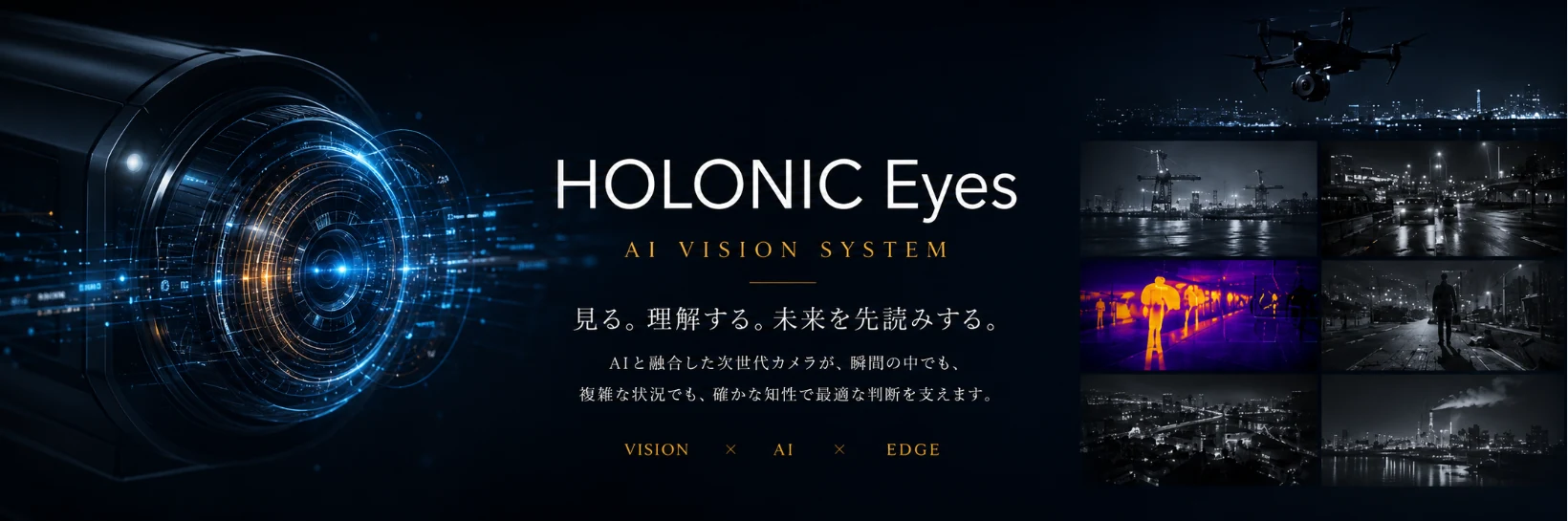
Image text translation
Reference translation prepared for this website. The source image is unchanged; this is not an original or certified translation.
HOLONIC Eyes / AI Vision System
See. Understand. Anticipate what comes next.
A next-generation camera integrated with AI supports informed decisions in fleeting moments and complex situations.
- Vision × AI × Edge
The lens on the left and the night-port, thermal, street and industrial scenes with a drone on the right illustrate the vision / AI / edge concept.
AI EYE / PRODUCT EVIDENCE
Starting with AI's eyes. Turn low-light scenes into color visual data.
HOLONIC Eyes HE-1 is a tangible AI EYE product at the entry point to Vertically Integrated Physical AI. Standalone product evaluation and adoption are also available. Where needed, a PoC assesses connections to Edge AI, drones, robots and distributed AI infrastructure.
Explore HE-1 capabilitiesINTELLECTUAL PROPERTY
Protect Physical AI business through public IP and IP design.
Alongside collaborative R&D and PoC, we define markets, data, implementation rights and licensing. Building on granted patents and published applications, we design IP arrangements for product development and deployment in Japan and abroad, project by project.
Explore public IPFAQ
Collaborative R&D, PoC and small AIDC inquiries
Even when early-stage details are undecided, we work with you to identify the conditions that need confirmation.
Can we consult you before deciding how to introduce AI?
Yes. We review your field challenge, data, installation environment and business objectives, then consider the right approach using AI cameras, Edge AI, local LLMs, small AIDC or collaborative R&D.
Can we discuss collaborative R&D with universities or experts?
We first define the challenge and research theme, then agree on validation methods, responsibilities, deliverables and data and IP handling. Advisory input and the team directly carrying out the project are confirmed separately. University or expert participation requires agreement and neither participation nor outcomes are guaranteed.
Are you a subsidy or grant application service?
Application services are not our core business. We design R&D themes, teams, PoC, IP and commercialization plans, considering public R&D programs where the project meets their requirements. Selection is not guaranteed.
Can we start with a small AI data center?
Published configurations include a 20-foot, 5-rack, 27 kW configuration. We assess phased adoption after confirming the use case, GPU, cooling, location, power conditions and maintenance.
START WITH YOUR CHALLENGE