Consultation procedures
A process that lets employees seek help and safely reach the responsible team.
Published patented detection and recording technology, alongside commissioned development of cameras, video analytics, Edge AI and management platforms. These two pathways support discussions of site-specific PoCs and joint development.

In Japan, from October 1, 2026, all employers must take employment-management measures to prevent workplace customer harassment.
A process that lets employees seek help and safely reach the responsible team.
Not every customer complaint is harassment. Legitimate requests within socially acceptable bounds are not harassment; people must review the individual circumstances.
Appropriate recording methods, protection of those involved and prevention of recurrence.
AI or audio/video recording equipment alone does not complete legal compliance. AI supports record organization and review; people and organizations make the final decisions.
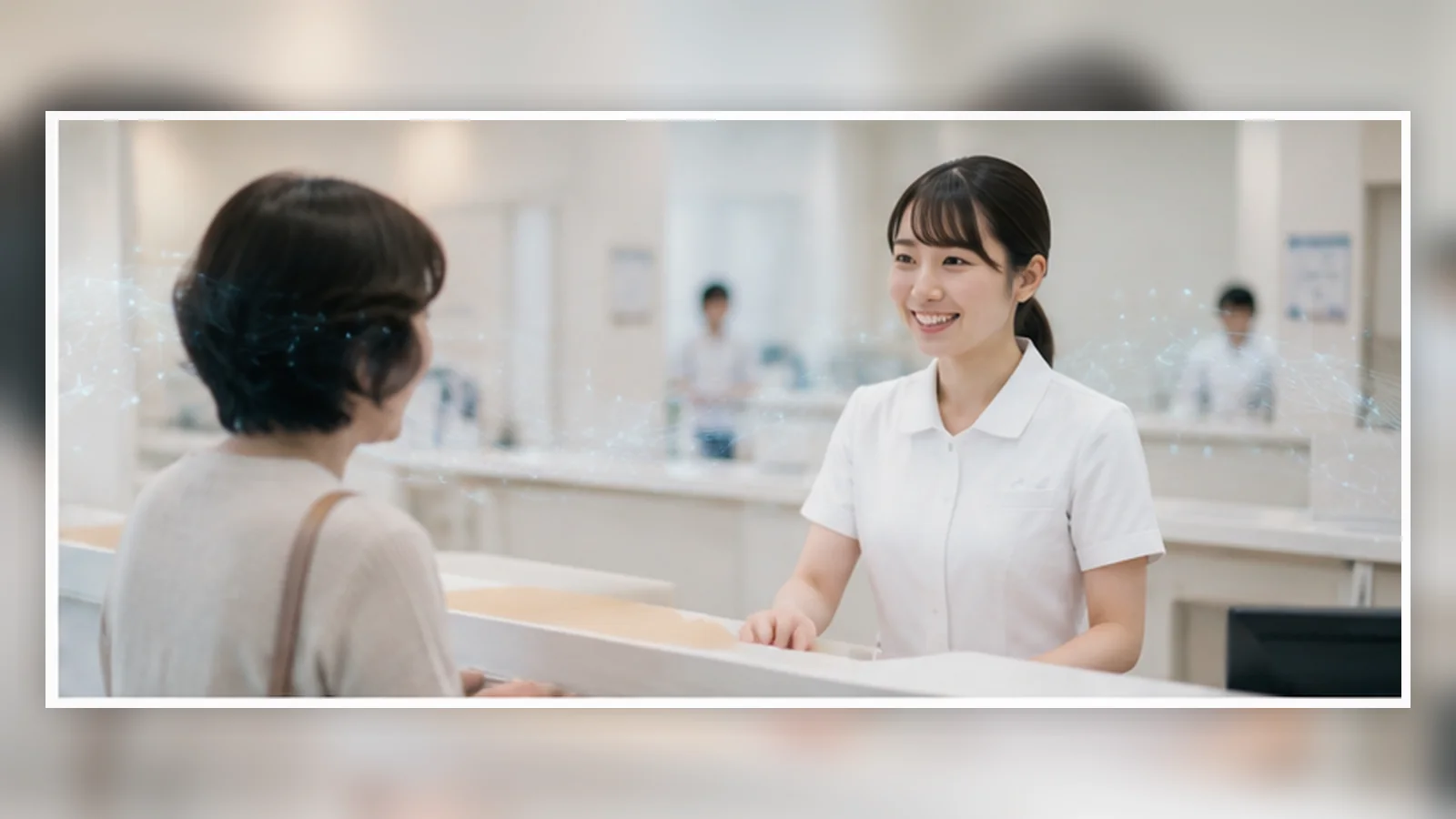 01
01
For organizations considering fact-finding, sharing information with managers and field PoCs.
Explore use cases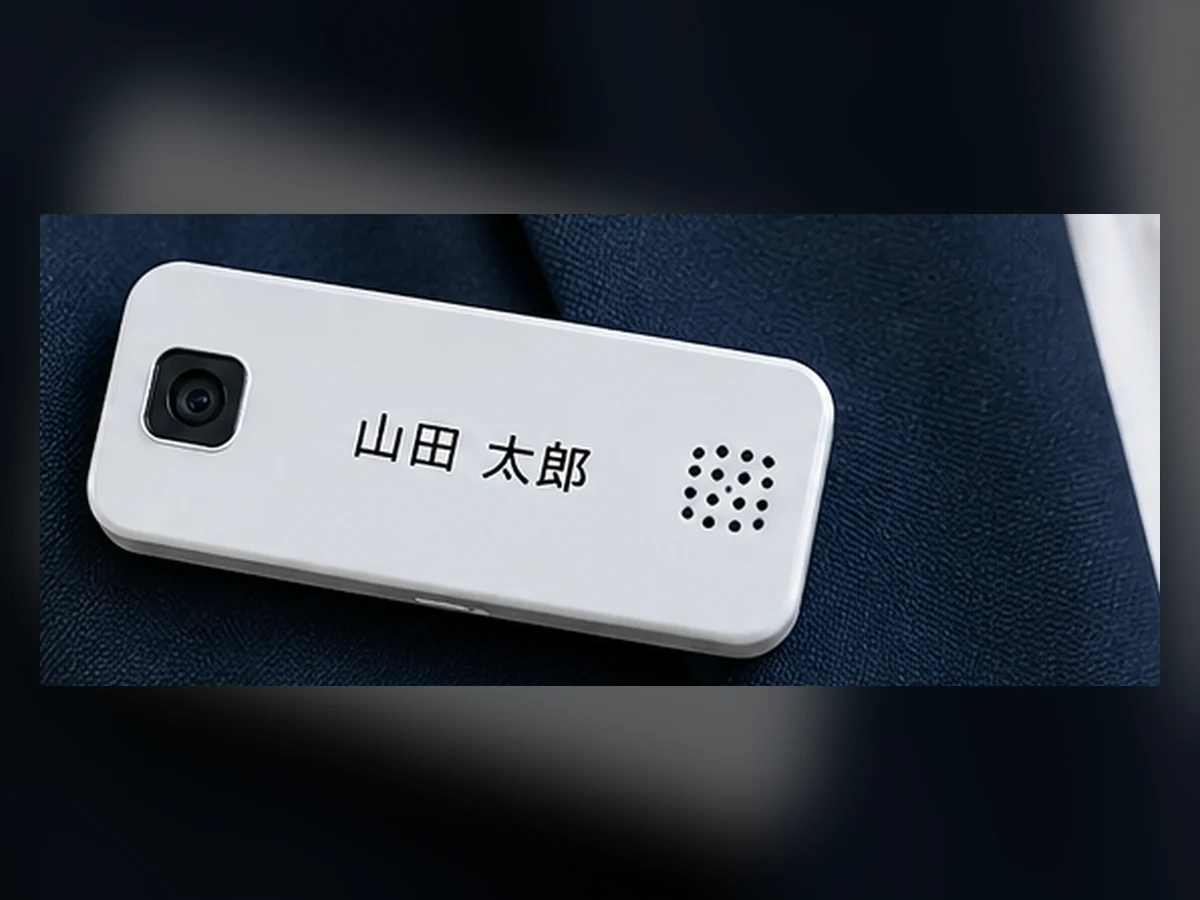 02
02
For businesses considering AI integration into recording devices, licensing and joint development.
Explore patents and integration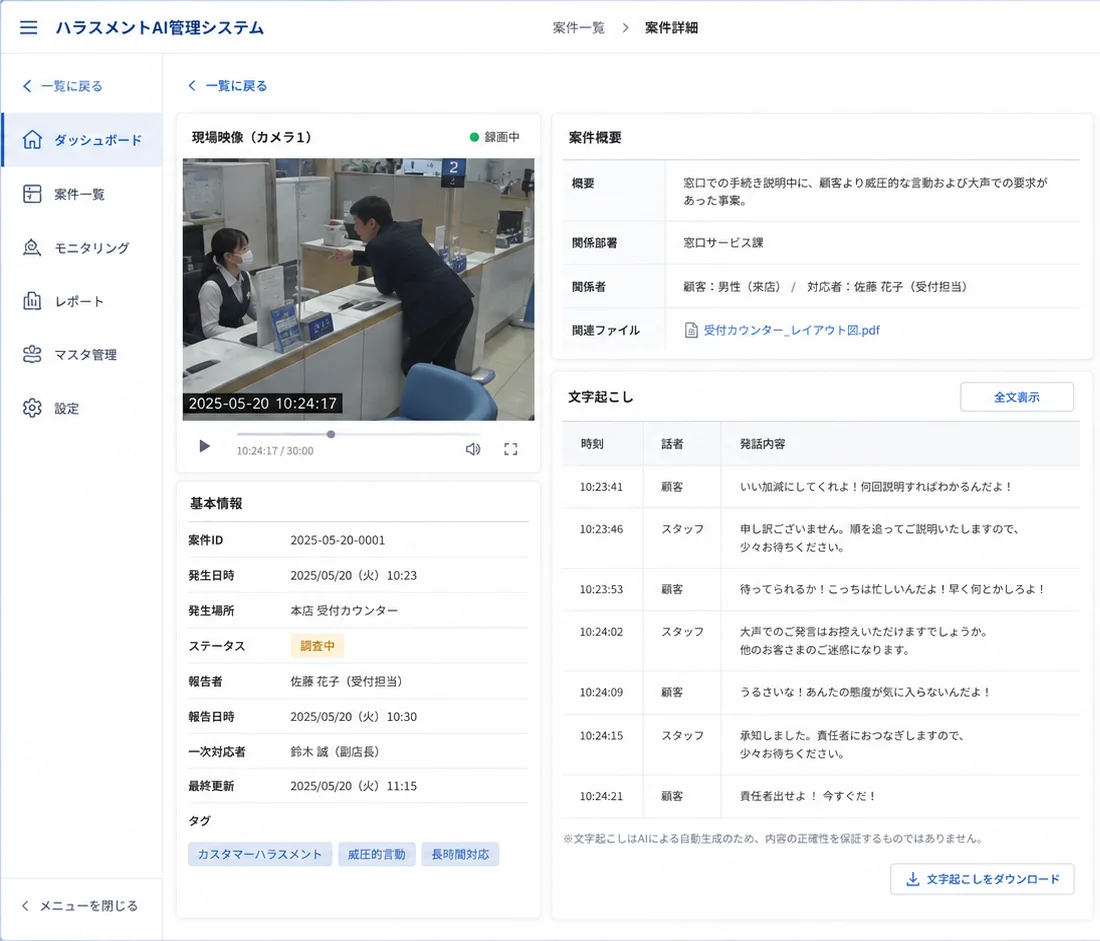 03
03
For organizations considering camera development, video analytics, Edge AI, management interfaces and API integration.
Explore development areasRead the full image translation beside the larger image below
In Japan, customer-harassment prevention measures become mandatory for employers on October 1, 2026 under Act No. 63 of 2025, promulgated June 11, 2025, amending the Act on Comprehensive Promotion of Labor Policies and related laws. The prevention guidelines are Ministry of Health, Labour and Welfare Notice No. 51 of 2026, issued February 26, 2026.
of companies reported an increase in consultations known to them
of companies had taken no customer-harassment measures
of workers reported no particular initiatives at their workplace
Source: FY2023 Survey Report on Workplace Harassment, commissioned by Japan's Ministry of Health, Labour and Welfare (March 2024, PwC Consulting LLC). Valid company responses: 7,780; worker and related respondents: 8,000.

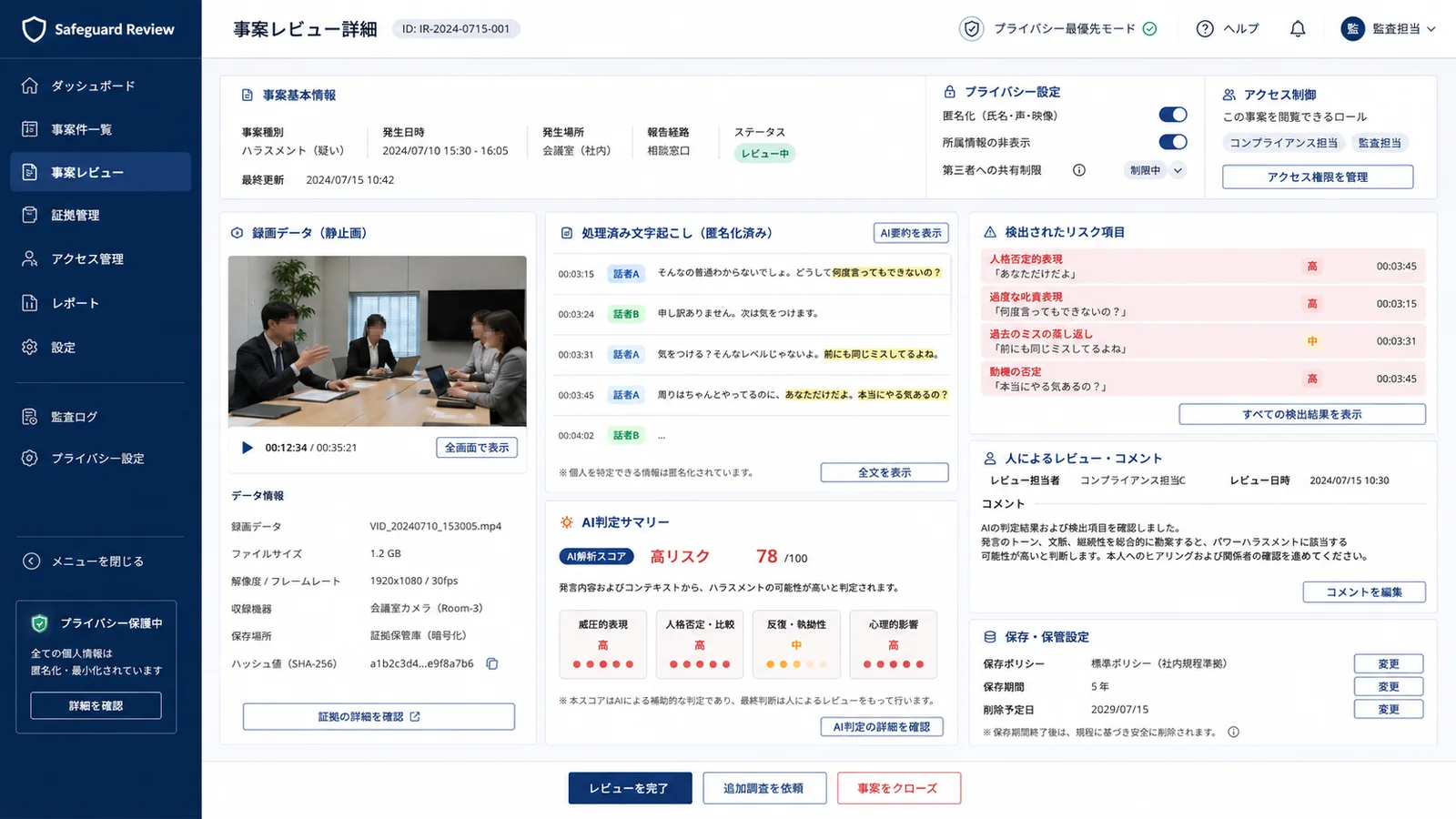
Image text translation
Reference translation prepared for this website. The source image is unchanged; this is not an original or certified translation.
Safeguard Review / incident review details / ID: IR-2024-0715-001
Privacy protection active / all personal information is anonymized and minimized / view details
Basic incident information
Privacy settings / access control
Recorded data (still image) / data information
Processed transcript (anonymized) / show AI summary
AI assessment summary / AI analysis score: high risk, 78/100
The screen's sample assessment states that the statements and context indicate a high possibility of harassment.
The score is an AI-assisted assessment; a human review makes the final determination. / View AI assessment details
Detected risk items
Human review and comments
I reviewed the AI assessment and detected items. Considering the tone, context and continuity of the statements together, I judge that they may be likely to constitute workplace power harassment. Please proceed with an interview of the person concerned and confirmation with the parties involved.
Storage and retention settings
After the retention period, the screen states that data will be securely deleted in accordance with policy.
Video and evidence metadata are on the left, anonymized transcript and AI-assisted assessment in the center, and risk items, human review and retention settings on the right. Bottom controls complete, investigate or close the review.
Site note: this is a conceptual screen. Scores, dates, findings and retention settings are examples, not a legal determination, validated accuracy, guaranteed anonymization or a prescribed retention period.
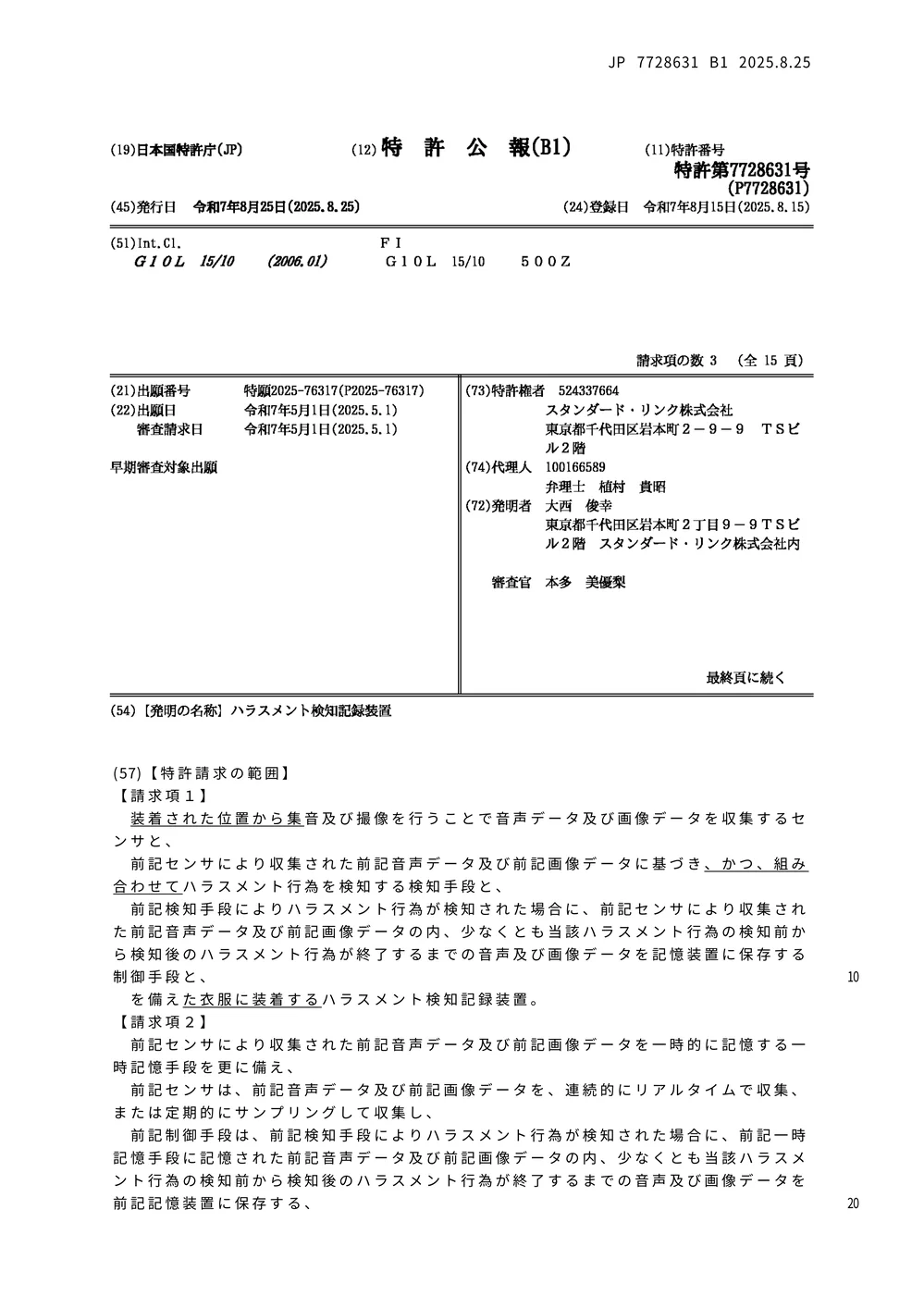 Enlarge patent publication
Image text translation
Reference translation prepared for this website. The source image is unchanged; this is not an original or certified translation.
JP 7728631 B1, 2025.8.25 / (19) Japan Patent Office (JP) / (12) Patent Gazette (B1)
(54) Title of invention: Harassment detection and recording device
(57) Claims / Claim 1
A sensor that collects audio data and image data by capturing sound and images from the position at which it is mounted;
detection means that detects harassment behavior based on, and by combining, the audio data and image data collected by the sensor; and
control means that, when harassment behavior is detected by the detection means, stores in a storage device, from among the audio data and image data collected by the sensor, at least the audio and image data from before detection of the harassment behavior until the harassment behavior ends after detection;
a harassment detection and recording device comprising the above and worn on clothing.
Claim 2
Further comprising temporary storage means that temporarily stores the audio data and image data collected by the sensor;
the sensor collecting the audio data and image data continuously in real time, or collecting them by periodic sampling;
the control means, when harassment behavior is detected by the detection means, storing in the storage device, from among the audio data and image data stored in the temporary storage means, at least the audio and image data from before detection of the harassment behavior until the harassment behavior ends after detection,
The upper half contains bibliographic information. The lower half shows Claim 1 and the opening of Claim 2; Claim 2 continues beyond this image. The right-margin numbers 10 and 20 are line numbers. This image is page 1, not all 15 pages or all three claims.
Site note: this reference translation does not determine legal claim scope. The Japanese gazette is the source document, and the address is reproduced as published at that time, not as the current company contact address. No omitted continuation has been invented.
The granted publication discloses configurations combining audio and images and preserving records before and after detection. Refer to the granted publication for the precise scope of rights.
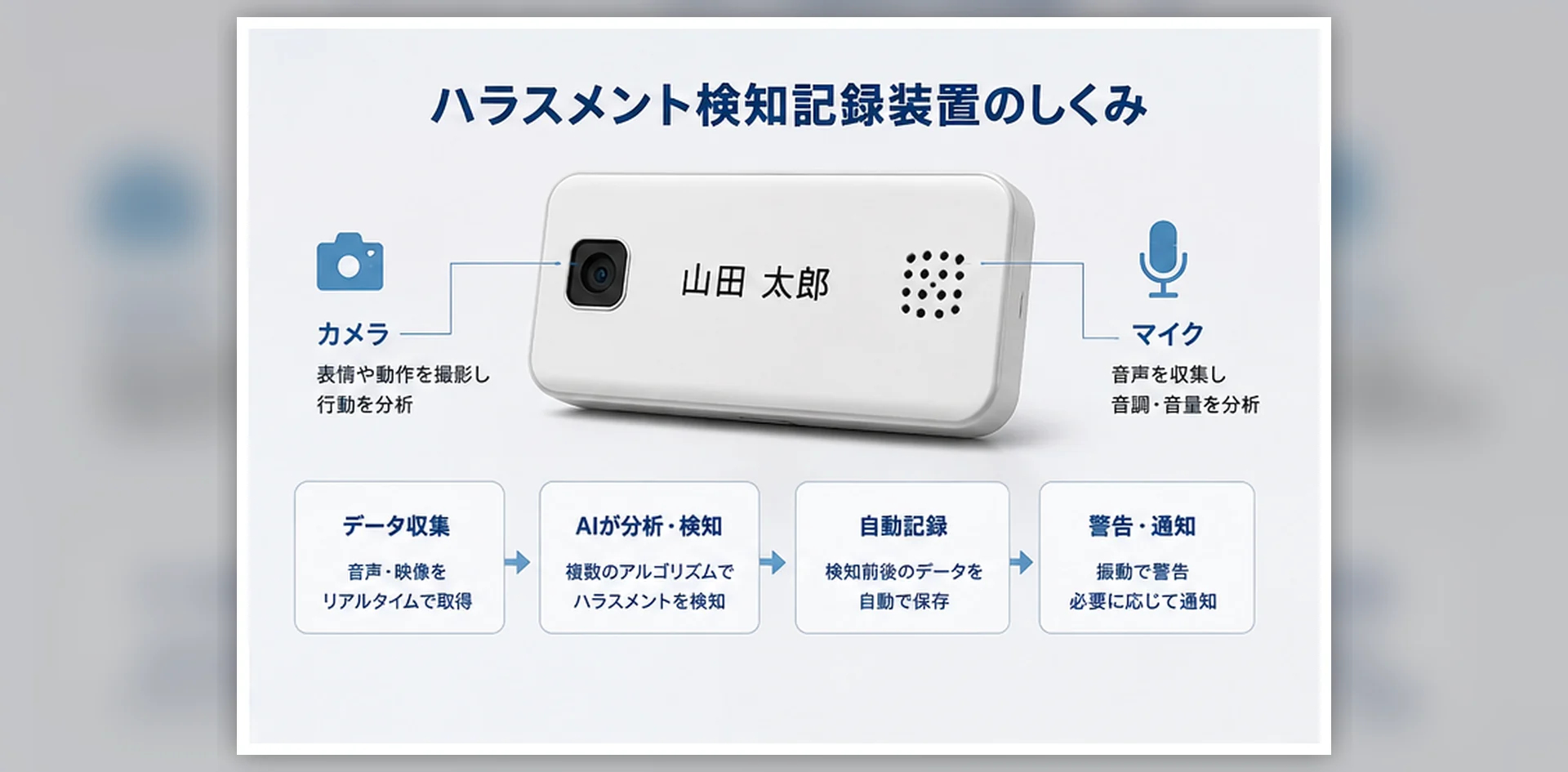
Image text translation
Reference translation prepared for this website. The source image is unchanged; this is not an original or certified translation.
How the harassment detection and recording device works
Camera
Captures facial expressions and movements for behavior analysis.
Microphone
Collects audio for analysis of tone and volume.
Leader lines locate the camera and microphone on the illustrated badge. The four lower boxes run left to right: collect, analyze / detect, record, then alert / notify.
Site note: this is a concept illustration, not the complete patent claims or a guarantee of a finished product, detection accuracy or every depicted function.
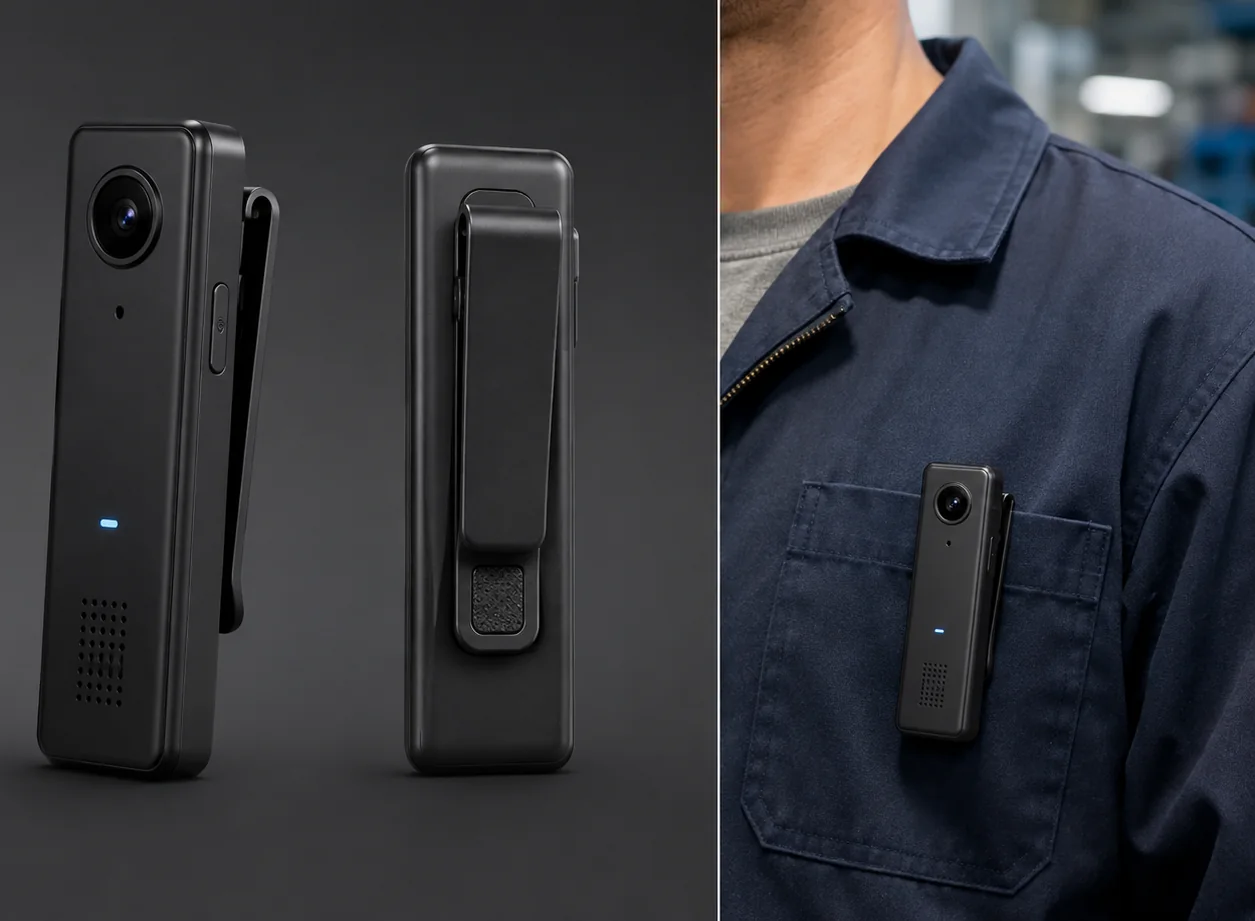
For in-person services and mobile work
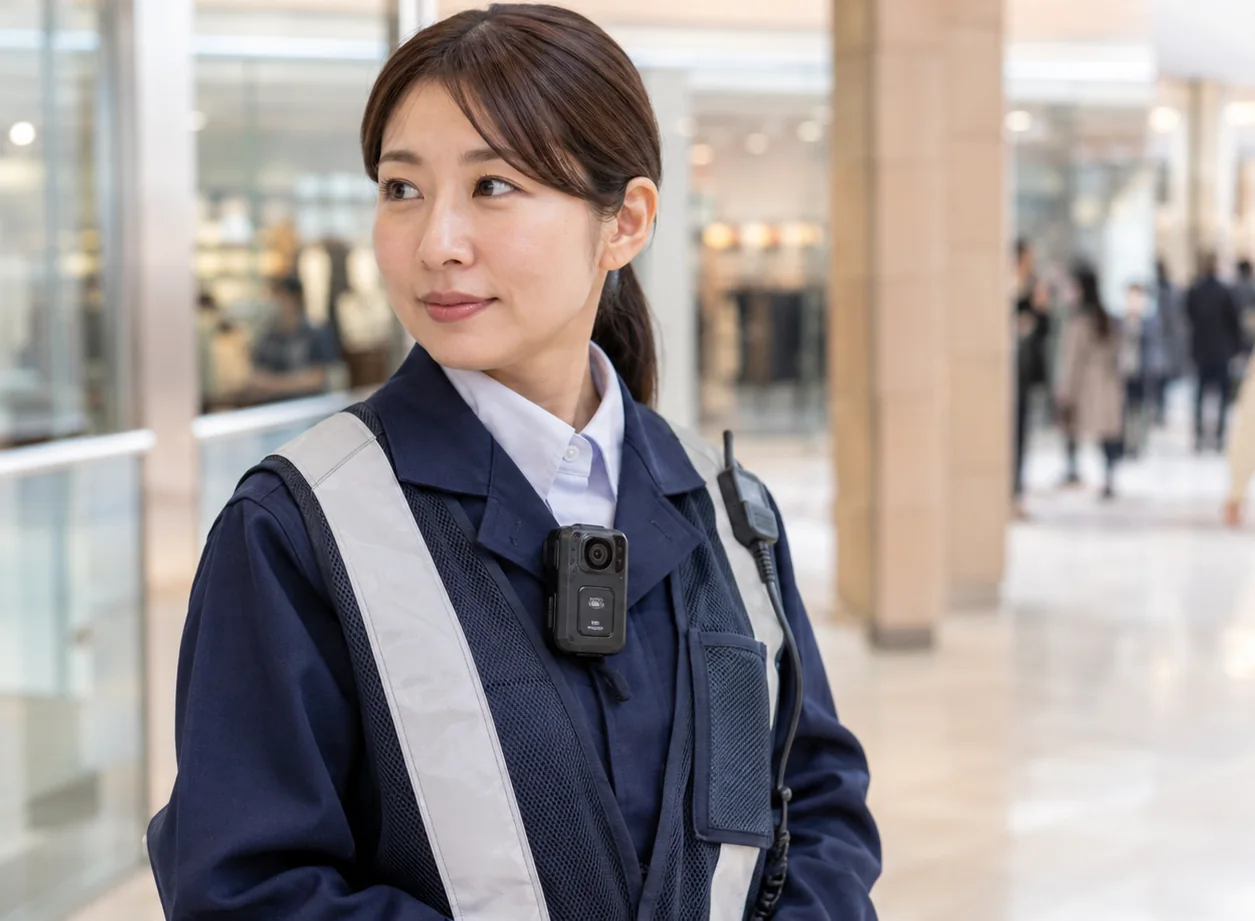
Portable use at reception and information counters
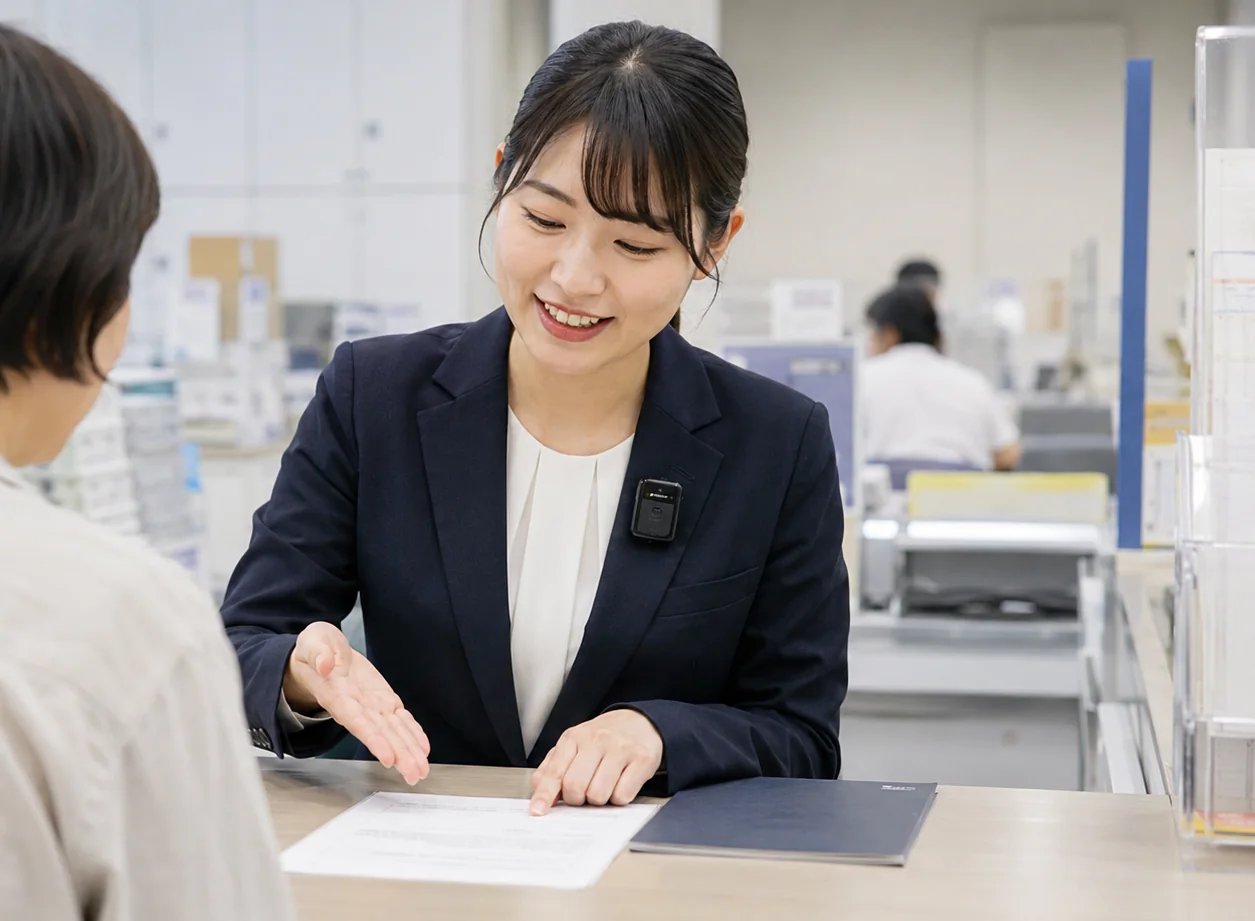
For discussions of compact, portable form factors
These examples are implementation candidates, not determinations of whether individual products fall within patent rights.



Refer to the granted publication for the precise scope of Japanese Patent No. 7728631. Fixed cameras, general video analytics, Edge AI and management platforms below are presented as SLL's separate commissioned-development business, not as an explanation of that patent's scope.
This page does not determine whether individual products fall within patent rights.
Discuss commissioned development, PoCs and joint development.
Discuss AI developmentStandard Link distinguishes intellectual-property explanations from implementation services.
DEVELOPMENT / WHAT WE CAN BUILD
An application layer that analyzes information available on site, including existing surveillance cameras, uploaded video, audio and portable devices, supporting incident discovery, clipping, objective review, evidence organization and sharing.
Standard Link covers camera and device selection and development, AI analytics, edge processing, management interfaces and operational design as an integrated project.
Read the full image translation beside the larger image below
Make it easier to locate video and audio intervals that staff should review.
Organize related video, audio and text as incident-level review material.
Connect review, sharing and response records according to permissions and operating procedures.
Image text translation
Reference translation prepared for this website. The source image is unchanged; this is not an original or certified translation.
Harassment AI management system / case list > case details
On-site video (camera 1) / recording
Basic information
Case overview
Summary: an incident involving intimidating behavior and loudly voiced demands by a customer during an explanation of counter procedures.
Transcript / show full text / time, speaker and spoken content
The transcript is automatically generated by AI; its accuracy is not guaranteed.
The left panels pair video with case metadata; the right panels show the overview and time-stamped transcript. Playback, volume, full-screen and download icons indicate the proposed controls.
Site note: this is a conceptual development screen. Names, incidents and timestamps are sample screen content, not a report of a verified real case or a completed product.
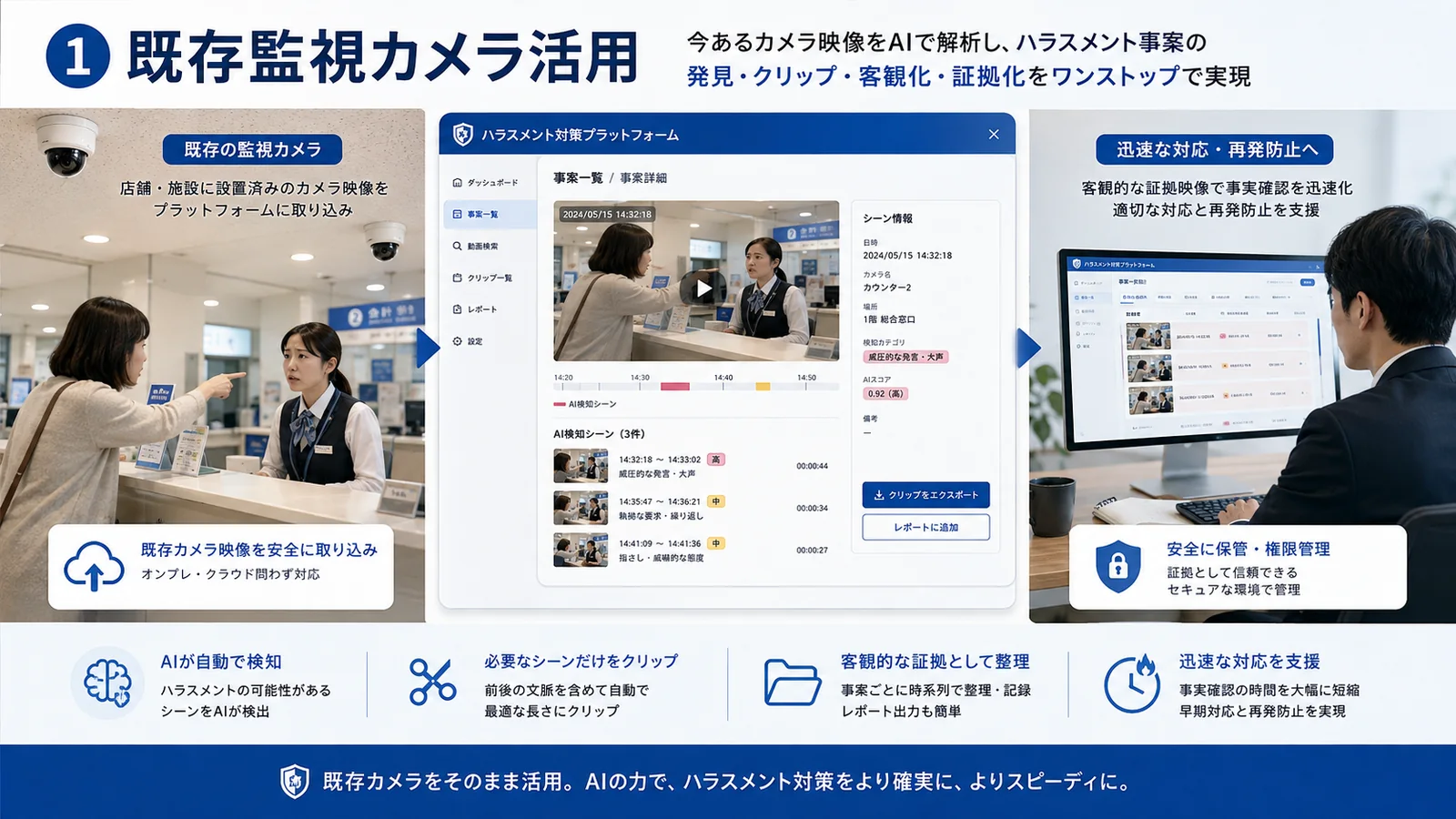
Image text translation
Reference translation prepared for this website. The source image is unchanged; this is not an original or certified translation.
1. Using existing surveillance cameras
Analyze existing camera footage with AI in one workflow for discovering incidents, creating clips, supporting objective review and organizing evidence.
Existing surveillance cameras
Import footage from cameras already installed in shops and facilities into the platform.
Harassment-response platform / incident list and details
Toward faster response and recurrence prevention
Use evidence footage to speed up fact checking and support appropriate responses and recurrence prevention.
Reuse existing cameras. The concept aims to make harassment response more dependable and faster with AI.
Arrows lead from existing cameras on the left to AI detection / clipping in the center and human review / retention on the right. Four functions are summarized below.
Site note: a development configuration example. Scores such as 0.92 are screen examples, not validated detection performance or a guarantee of legal evidentiary value. Compatibility and operational requirements must be assessed individually.
Receive video from cameras already installed in shops, stations, hospitals and public counters; extract intervals for review and organize clips with related information by incident. Define connection methods, recording formats and storage locations individually in the PoC.
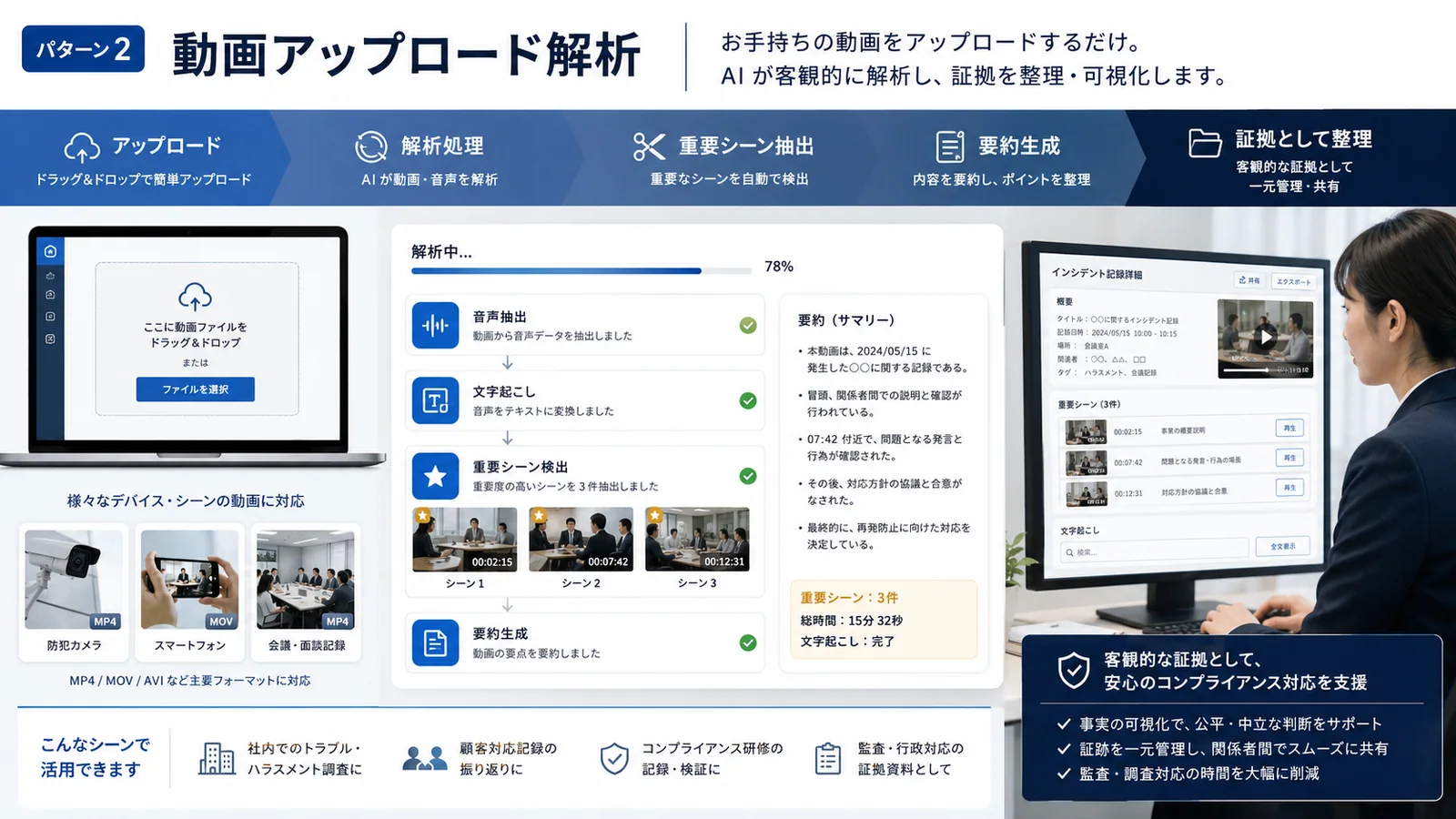
Image text translation
Reference translation prepared for this website. The source image is unchanged; this is not an original or certified translation.
Pattern 2: uploaded-video analysis
Upload an existing video; the proposed AI workflow analyzes it and organizes and visualizes material for evidence review.
Analyzing... 78%
Summary
Incident-record details
The concept supports compliance review by visualizing facts for fair, neutral judgment, managing evidence centrally for sharing among authorized parties, and aiming to reduce time spent on audits and investigations.
The left-side upload feeds into extraction, transcription, key-scene selection and summary generation in the center, then into a record for human review on the right.
Site note: a development-screen example, not validated accuracy, timing, universal format support, legal evidentiary value or a measured time-saving guarantee. The example's different duration labels are reproduced rather than recalculated.
Post-process exported security-camera footage, smartphone videos and meeting or interview records. Rather than requiring real-time processing, focus on extracting important scenes, summarizing and generating review clips.
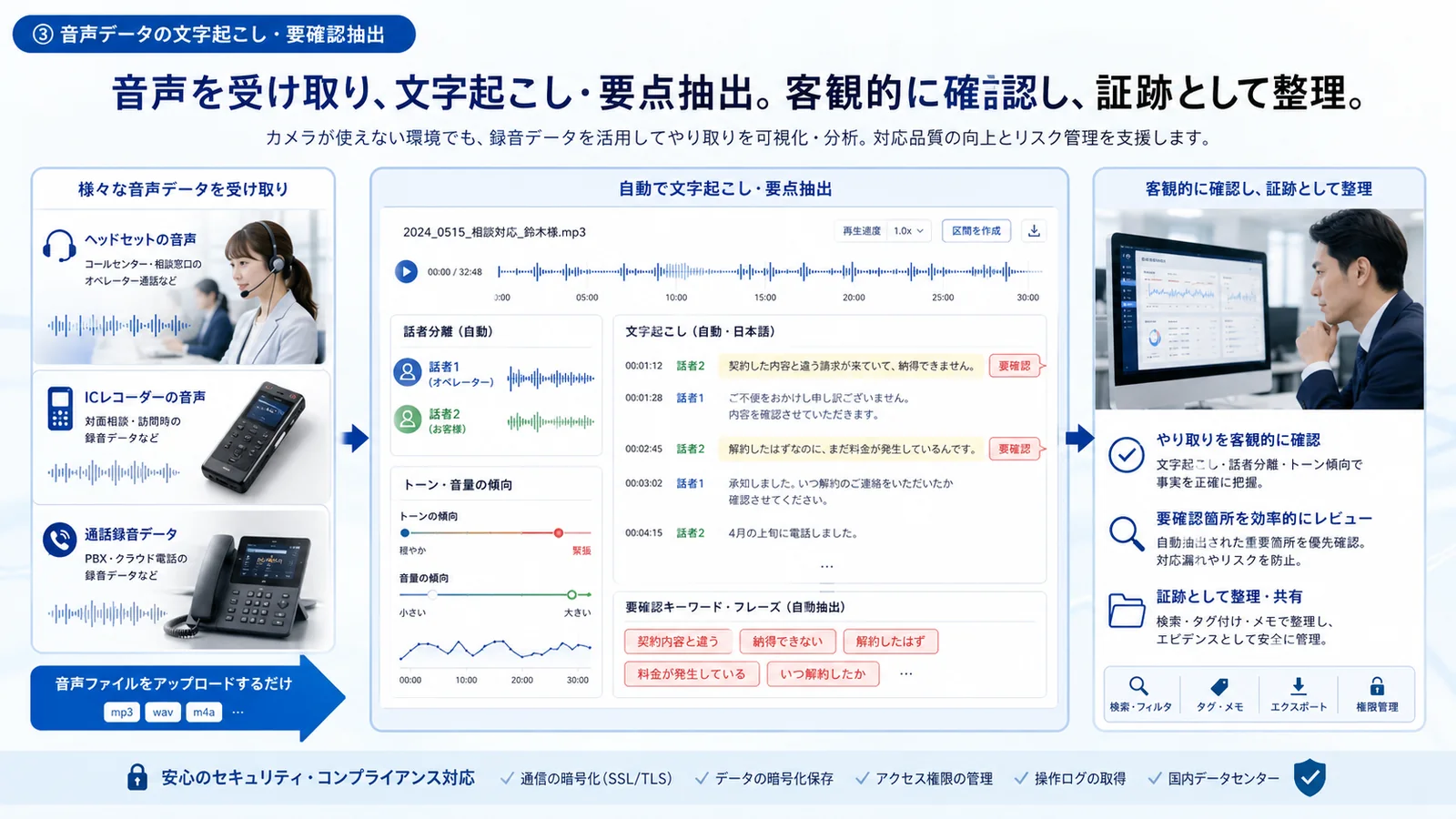
Image text translation
Reference translation prepared for this website. The source image is unchanged; this is not an original or certified translation.
3. Audio transcription and extraction of items requiring review
Receive audio, transcribe it and extract key points. Review it objectively and organize the record.
Even where cameras cannot be used, recorded audio can help visualize and analyze interactions, supporting service-quality improvement and risk management.
Receive different types of audio
Automatic transcription and key-point extraction
Automatic transcript (Japanese in the source screen)
Objective review and organization of records
Three input types on the left feed the central transcription / key-point process, then human review and record management on the right. The lower band lists security design items.
Site note: a concept screen, not verified transcription accuracy, speaker / emotion recognition, format compatibility, guaranteed security or a universal domestic-storage promise. These conditions require project-specific confirmation.
After recording, apply speaker separation, transcription and extraction of review intervals to call-center calls, telephone inquiries, interviews and voice-recorder files. Prioritize reliable retrospective review and stable operations rather than mandatory real-time processing.
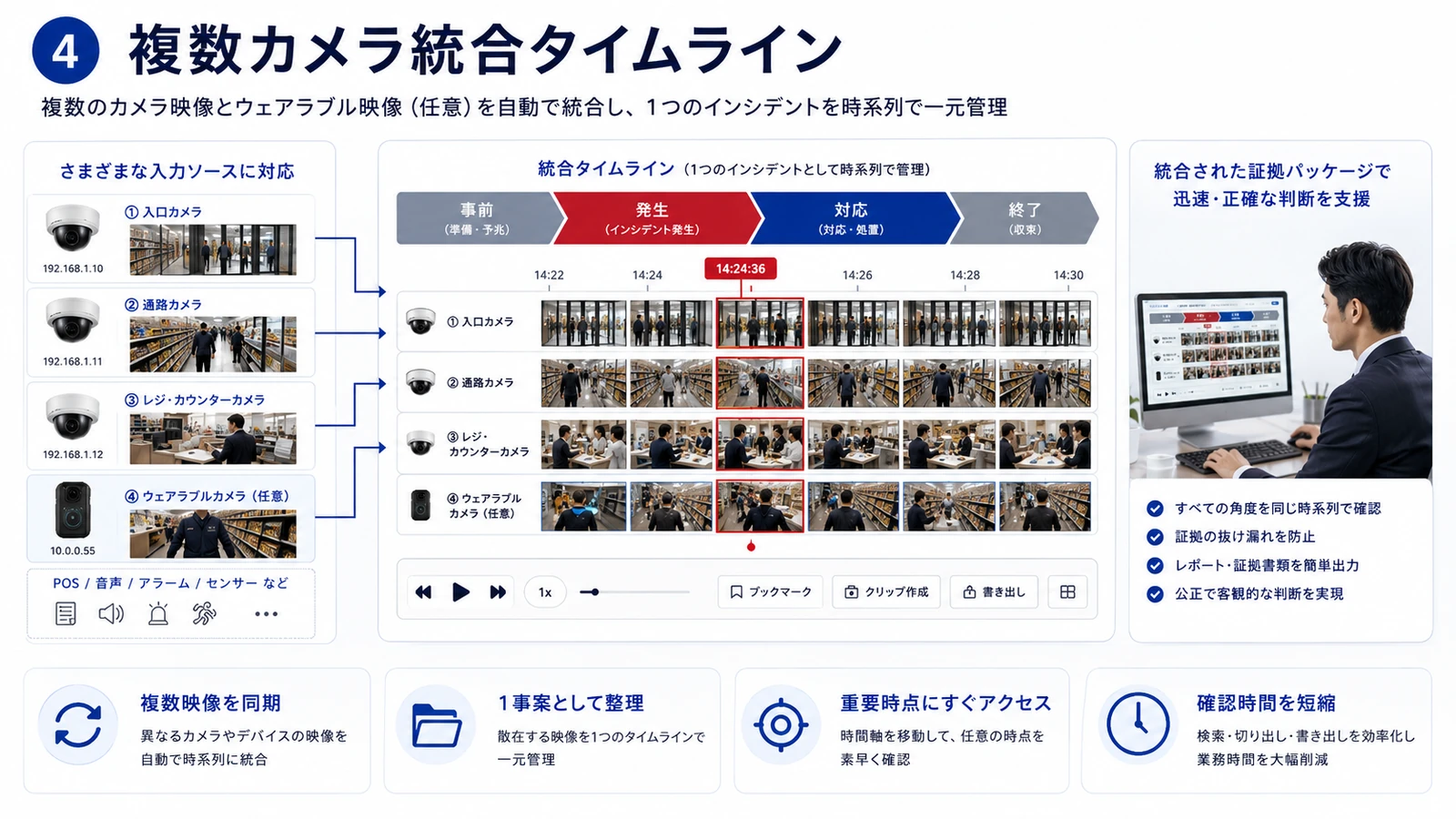 Enlarge in a new window
 Image text translation
Reference translation prepared for this website. The source image is unchanged; this is not an original or certified translation.
4. Multi-camera integrated timeline
Automatically integrate footage from multiple cameras and optional wearable devices to manage one incident chronologically in a single place.
Various input sources
Integrated timeline: chronological management as one incident
An integrated evidence package to support timely, informed decisions
Each of four input arrows corresponds to one footage row. A red vertical marker aligns the selected instant across all rows. Human review is shown on the right; intended benefits are listed below.
Site note: IP addresses and times are illustrative labels in the concept image, not actual network access information or proven synchronization performance. Device integration, time alignment and evidence handling require individual validation.
Align sources such as entrances, corridors, checkout counters, service desks and optional portable-device video on one timeline. Do not promise unconditional identity matching; validate incident organization using times, locations and event information in stages.
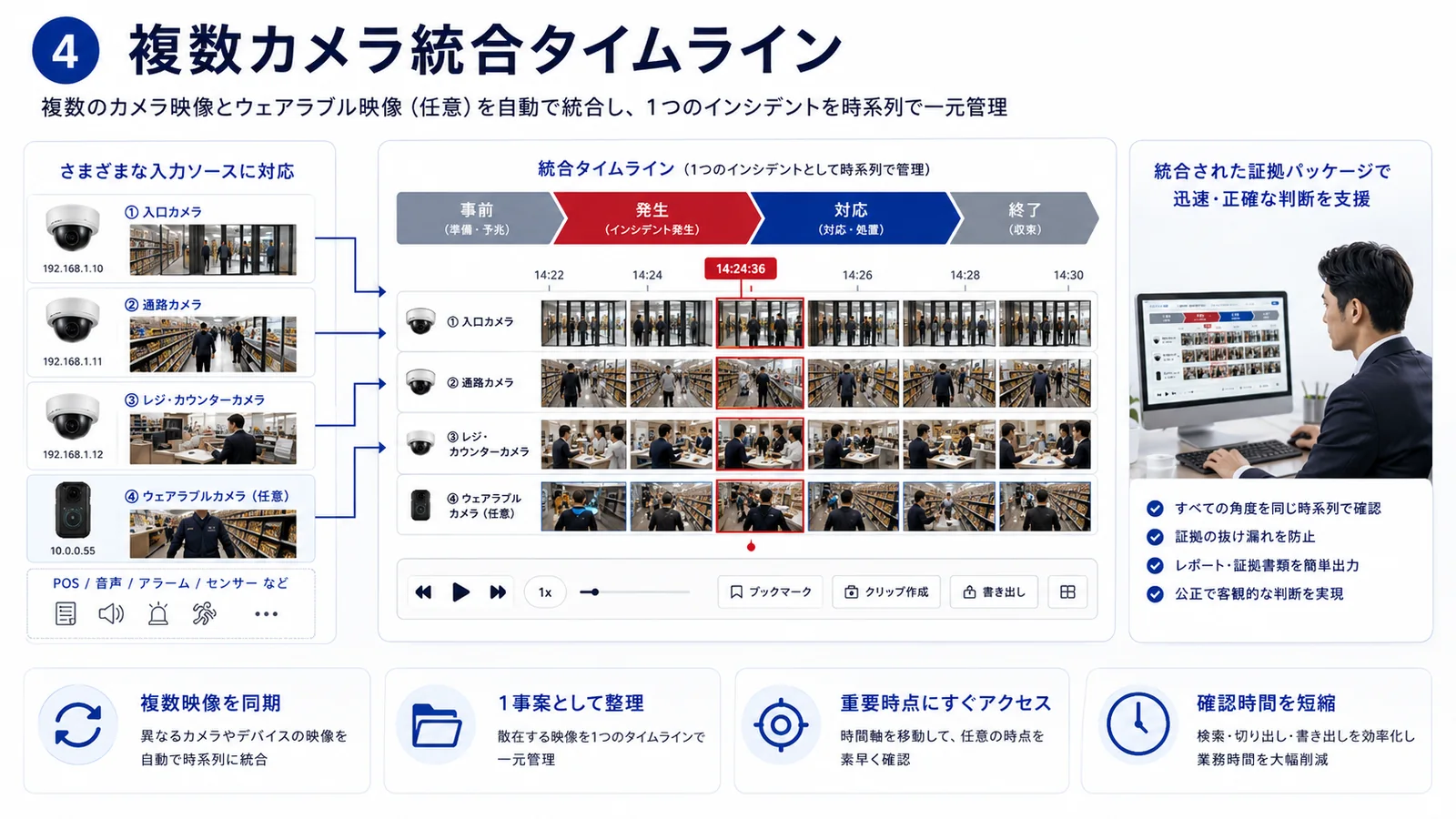
Image text translation
Reference translation prepared for this website. The source image is unchanged; this is not an original or certified translation.
4. Multi-camera integrated timeline
Automatically integrate footage from multiple cameras and optional wearable devices to manage one incident chronologically in a single place.
Various input sources
Integrated timeline: chronological management as one incident
An integrated evidence package to support timely, informed decisions
Each of four input arrows corresponds to one footage row. A red vertical marker aligns the selected instant across all rows. Human review is shown on the right; intended benefits are listed below.
Site note: IP addresses and times are illustrative labels in the concept image, not actual network access information or proven synchronization performance. Device integration, time alignment and evidence handling require individual validation.
Bring video, audio, text, review clips, staff comments and response history together by incident to support internal review and reporting. AI assists factual organization; people retain final judgment and approval.
Images are configuration concepts, not finished product specifications, deployment records or detection-accuracy evidence. AI supports human and organizational review and judgment; it does not determine legal assessments.
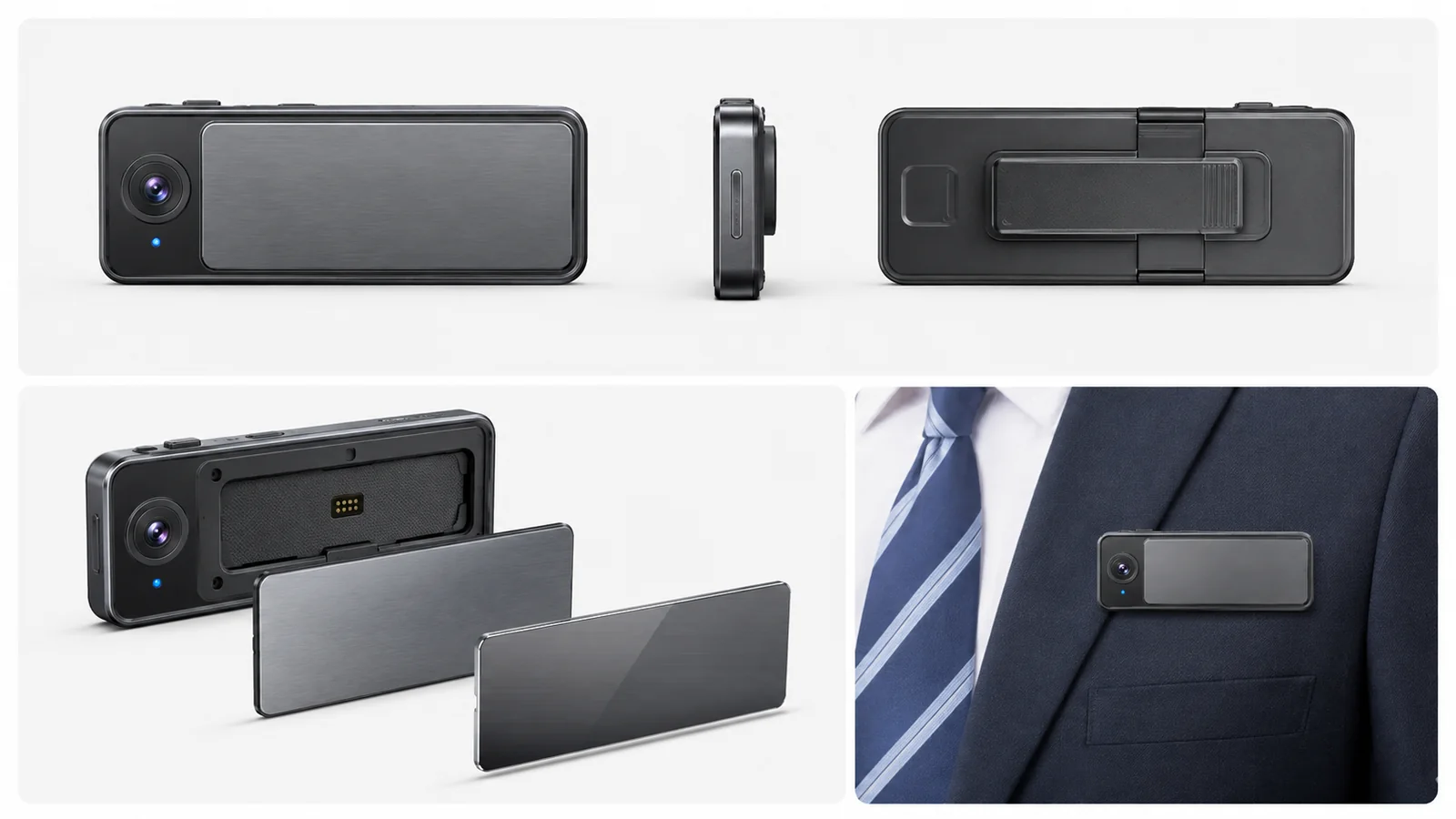
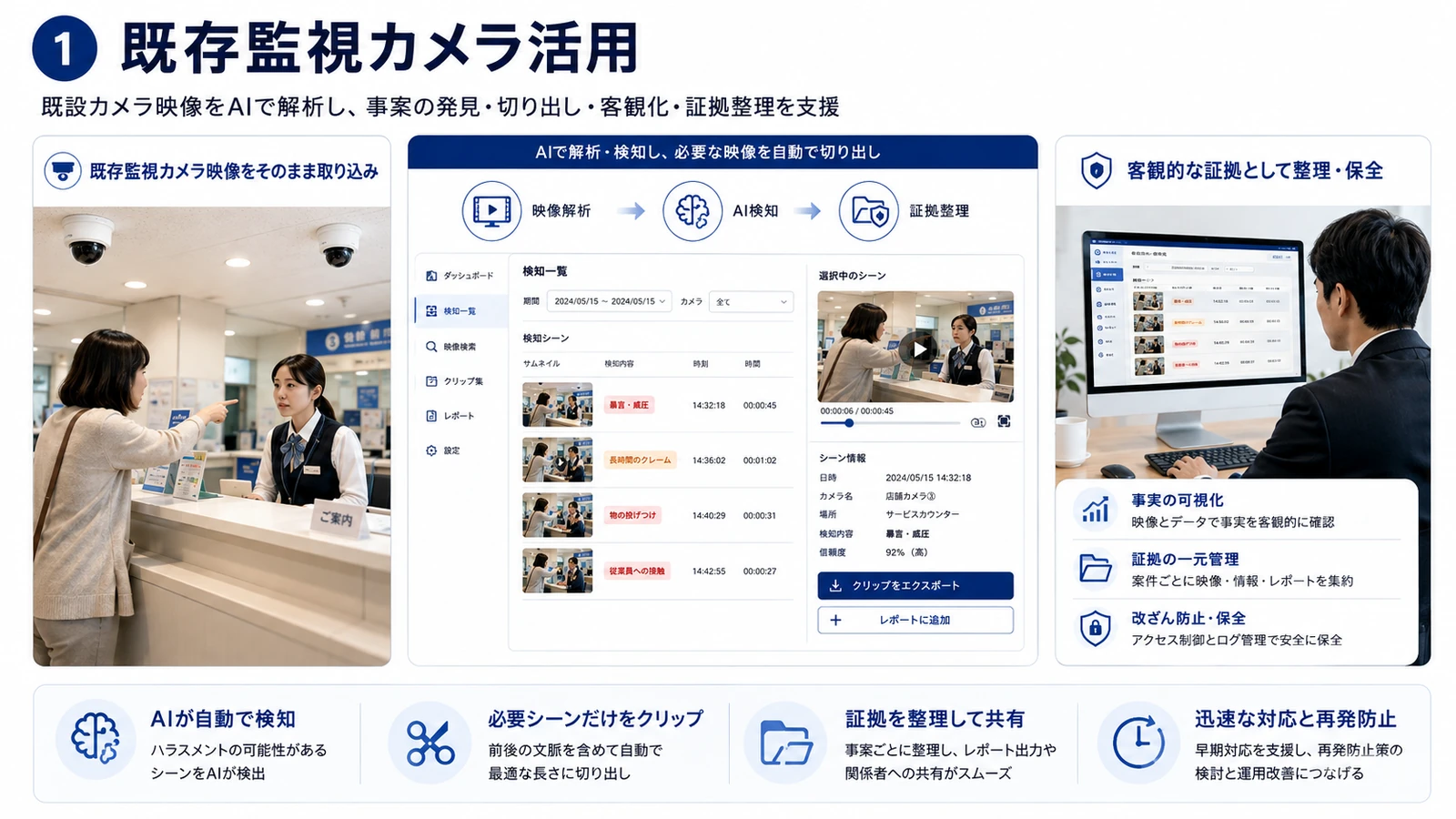
Image text translation
Reference translation prepared for this website. The source image is unchanged; this is not an original or certified translation.
1. Using existing surveillance cameras
Analyze installed-camera footage with AI to support incident discovery, clipping, objective review and evidence organization.
AI analysis and detection with automatic clipping of relevant footage
Organize and preserve evidence for objective review
The image flows from field footage on the left through the detection interface in the center to human review and preservation on the right. Four supporting functions are listed below.
Site note: 92% is a conceptual-screen value, not measured detection accuracy. The example does not guarantee legal evidentiary value, immunity from tampering or compatibility with every camera.
Video analytics using existing equipment
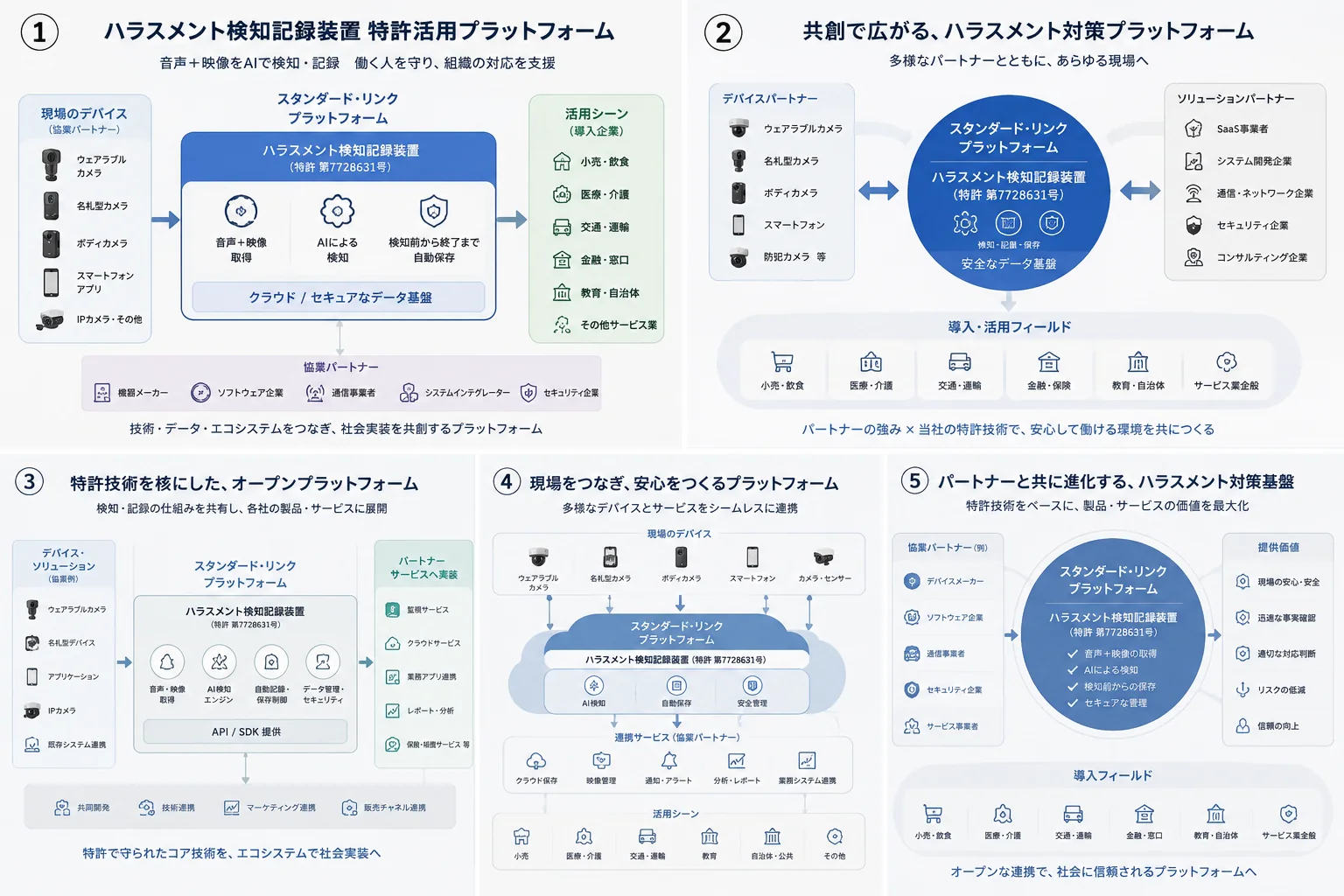
Image text translation
Reference translation prepared for this website. The source image is unchanged; this is not an original or certified translation.
1. Harassment detection and recording device: patent-use platform
AI detection and recording using audio and video: protecting workers and supporting organizational responses.
A platform linking technology, data and an ecosystem to co-create real-world deployment.
2. A harassment-response platform expanded through co-creation
Working with diverse partners across field environments.
Combining partners' strengths with our patent technology to co-create workplaces where people can work with confidence.
3. An open platform centered on patent technology
Share detection and recording mechanisms for application in partners' products and services.
Bringing the patent-protected core technology into real-world use through an ecosystem.
4. A platform connecting field sites and supporting peace of mind
Integrating diverse devices and services.
5. Harassment-response infrastructure evolving with partners
Using patent technology as a foundation to enhance product and service value.
An openly connected platform for real-world deployment.
Panel 1 runs devices → core platform → applications, supported by partners below. Panel 2 links both partner groups bidirectionally with the center. Panel 3 connects inputs → core → partner services. Panel 4 flows downward from devices through the platform and connected services to applications. Panel 5 links partners → core → value, with deployment sectors below.
Site note: the five panels are development / collaboration concepts. They do not establish that every device, service or function falls within Patent No. 7728631, is already available, or has a contracted partner. The patent scope is described separately using the published claims.
Selection and integration for site conditions
Fixed cameras and general video analytics are available for discussion as commissioned development separate from this patent.
From using existing cameras to defining and developing new AI-camera and video-analysis functions.
Process recordings after capture and organize review intervals, transcripts and key points by incident.
Integrate on-site inference, closed-network environments and low-latency processing according to operating conditions.
Design management interfaces for incident lists, review, permissions, notifications and staff collaboration.
Connect cameras, microphones, portable devices and existing equipment to fit workflows and data requirements.
Define validation scope and evaluation methods, supporting decisions from PoCs through joint development and commercialization.
Add audio/video analysis and event extraction to recording-only equipment.
Discuss product integrationDesign cameras, microphones and edge computers for specific site conditions.
Discuss camera developmentManage incidents, video, notifications and permissions across sites in one interface.
Discuss platform developmentValidate in airports, healthcare, hospitality or public counters, then assess sales and commercialization.
Discuss co-creationSeparate capture, analysis, incident extraction, record preservation and workflow integration, combining only what each site needs.
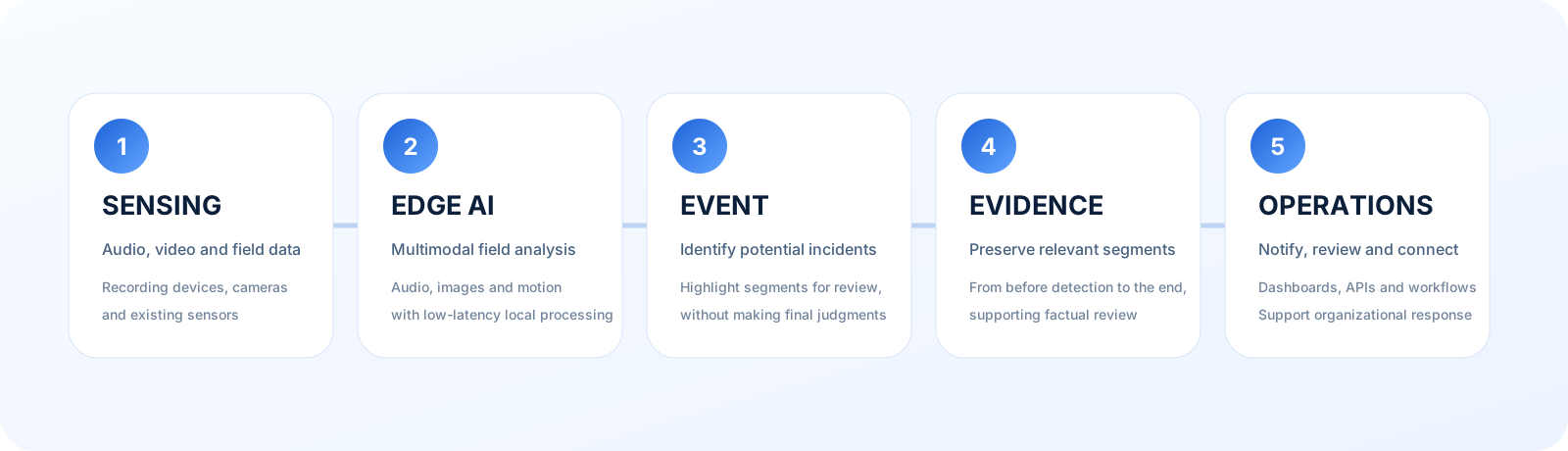

In-person assistance in high-traffic locations

Fact-finding and information sharing in customer service
Reception, information and consultation desks

In-person reception at local-government and public facilities

Workflow design for varied in-person services

Mobile and in-person duties such as patrols and staffed posts
Images are illustrative, not specific products, actual deployments or performance evidence.
Camera and video inputs, including sensing for low-light and site conditions.
Explore the page → EDGE AIOn-site image/audio analysis and sensor fusion.
Explore the page → AI SOLUTIONSPoCs, commissioned AI development, management interfaces and workflow implementation.
Explore the page → AI INFRASTRUCTUREData storage, distributed processing and integration with operational infrastructure.
Explore the page →Clarify the site, challenges, existing equipment, data and operating conditions.
Define the scope of cameras/devices, AI processing, storage, notifications and interfaces.
Assess site suitability and operations, typically over four to eight weeks.
Discuss deployment, product integration, joint development, sales and business partnerships.
Consider continuous or periodic capture and temporary buffering according to the site and applicable law.
Define incident intervals, storage locations, access rights, closed-network configurations and activity logs.
Connect only necessary information to management interfaces, notifications, existing systems and APIs.
Yes. This page presents fixed cameras and general video analytics as SLL's separate commissioned-development business, not as an explanation of this patent's scope.
For existing video and audio the organization may lawfully handle, we confirm purpose, access permissions, retention and computing environment before considering incident clipping, timelines and sharing with staff. This is not an individual victim-support service or outsourced legal-compliance service.
We welcome discussions of management-platform design and development covering incident lists, timelines, video/audio review, permissions and notifications.
Japan's amended law and guidelines do not impose a blanket audio/video recording requirement. Organizational measures must include consultation channels, fact-finding, employee protection and prevention of recurrence. If records are used, confirm purpose, access rights, retention and personal-data handling. Installing equipment alone does not complete compliance.
People and organizations make the final decisions. AI handles audio, images and other information to support objective preparation of material for review.
Typically four to eight weeks, designed around scope and site conditions. NDA and closed-network environments can also be accommodated.
This technology is not intended for continuous surveillance of people.
An embodiment in the granted publication describes sensors capturing audio and images continuously or periodically, deleting or overwriting buffered data after a set time, and preserving at least the interval from before detection through the end of the conduct when harassment is detected.
Actual operations are designed to comply with Japan's Act on the Protection of Personal Information and other applicable laws.
No. The specification describes various forms of harassment in workplaces, schools and other settings, including sexual harassment, power harassment, gender harassment and customer harassment.
Describe your current challenge, existing equipment and data, and the intended setting. A finished specification is not required at the outset.
Describe your current challenge, existing equipment and data, and the intended setting. A finished specification is not required at the outset.
Contact us