Field value
What improves: time, workload, loss, safety or quality?
CORPORATE PHILOSOPHY
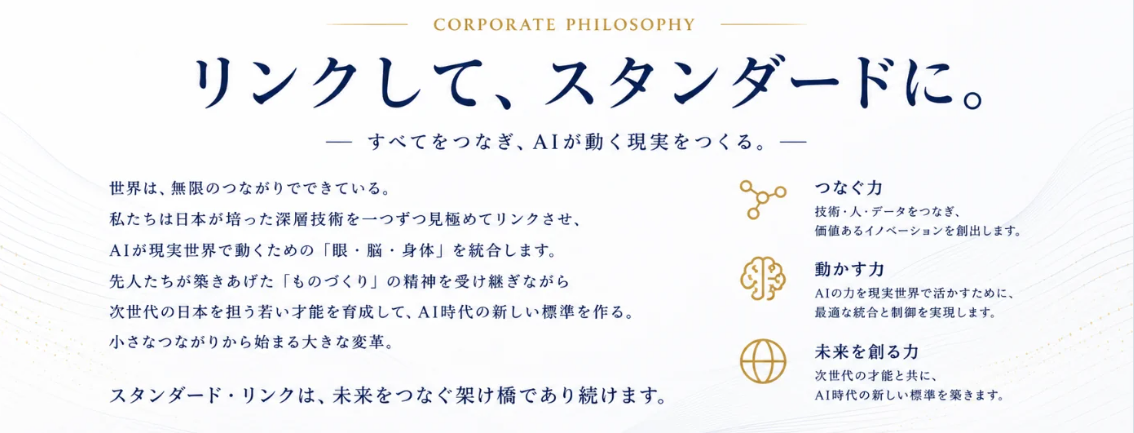
Link and set the standard.
Connect everything. Build a world where AI acts.
The world is made of infinite connections.
We identify and connect the deep technologies Japan has developed, integrating the eyes, brain and body that AI needs to operate in the real world.
Carrying forward the manufacturing spirit built by earlier generations,
we nurture the young talent who will shape Japan's next generation and establish new standards for the AI era.
Small connections can begin great change.
Standard Link will continue to be a bridge to the future.
Image layout: the full philosophy is on the left; the three capabilities are on the right, under the shared corporate-philosophy heading.
Reference translation prepared for this website. The source image is unchanged; this is not an original or certified translation.
We connect AI cameras, Edge AI, drones, robots and AIDC, designing the full path from field input to decisions, actions and learning.
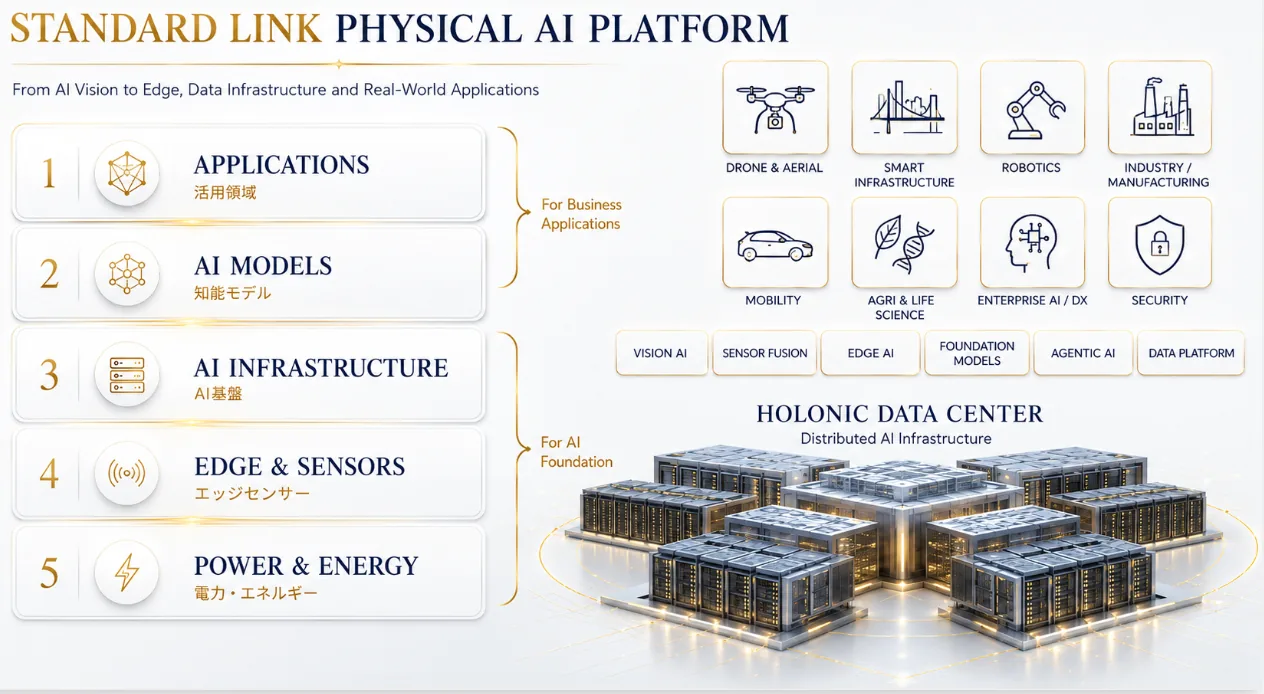
Image text translation
Reference translation prepared for this website. The source image is unchanged; this is not an original or certified translation.
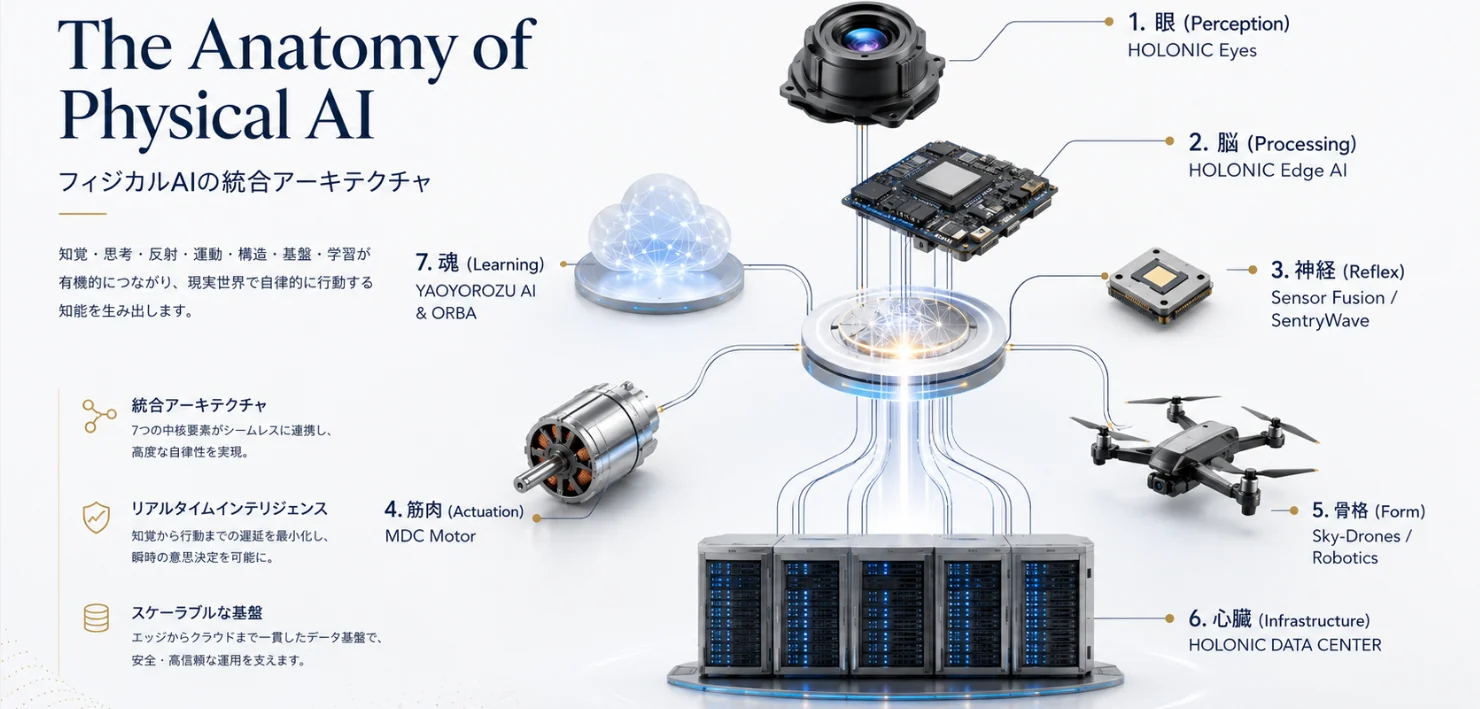
STANDARD LINK Physical AI Platform
From AI vision to edge computing, data infrastructure and real-world applications.
HOLONIC DATA CENTER / distributed AI infrastructure
On the left, layers 1–2 are grouped as business applications and layers 3–5 as the AI foundation. The right side places eight application areas above six technology categories and the distributed data-center foundation.
We design the whole system. You start where you need to, with product evaluation, a field challenge or collaborative R&D.
What improves: time, workload, loss, safety or quality?
Can the required input, decisions and actions work under actual field conditions?
What is collected, with whose permission, in what quantity and where is it processed?
Can it operate in the field with defined owners, procedures, maintenance and stopping criteria?
From cameras to data centers. Our integrated approach lets you start wherever you need.
Read the full image translation beside the larger image below
Color night vision at a reference 0.0007 lux under our evaluation conditions, combined with Edge AI. Turning previously unseen scenes into AI input.
Explore technology and products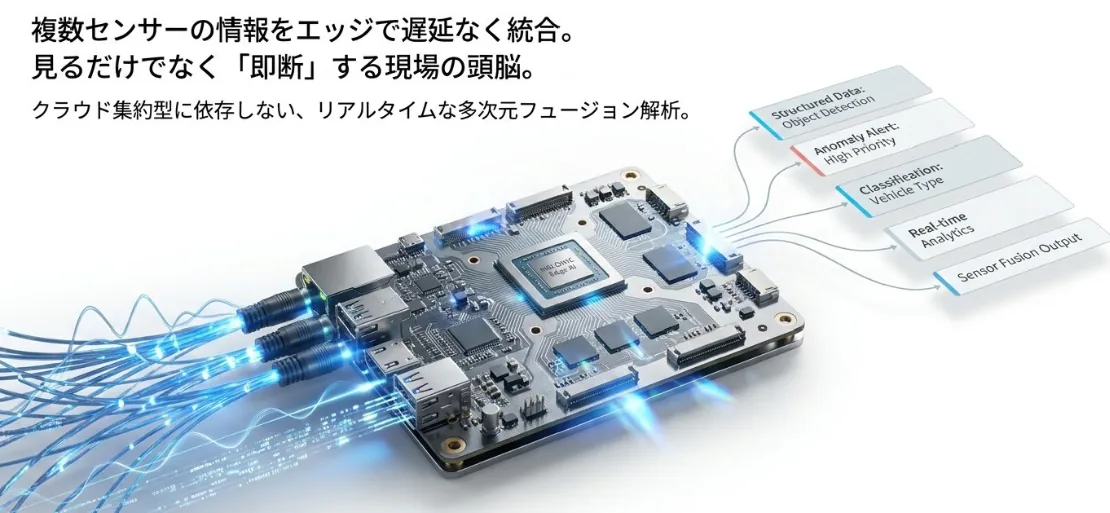
Read the full Edge AI image translation below
Image analysis, generative AI and local LLMs configured for each use case. Joint implementation from PoC and contract development through operation.
Explore AI solutions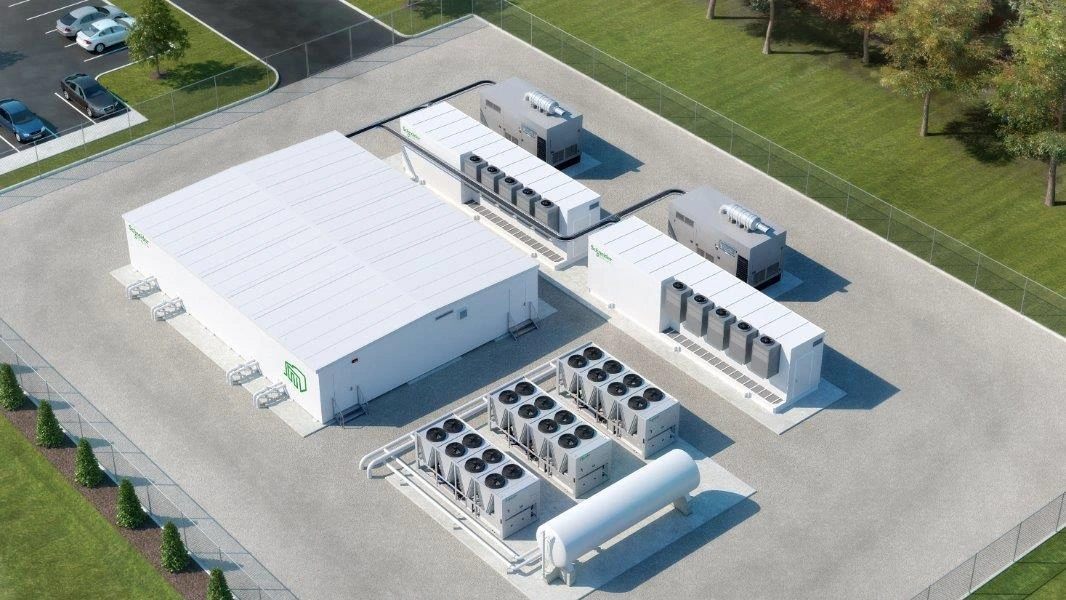
We assess the AI computing infrastructure required by your use case, data management, power and cooling conditions.
Explore our data center businessImage text translation
Reference translation prepared for this website. The source image is unchanged; this is not an original or certified translation.
The source concept describes integrating multiple sensor inputs at the edge without delay: an on-site brain that not only sees but makes immediate decisions.
Real-time, multidimensional fusion analysis without dependence on centralized cloud processing.
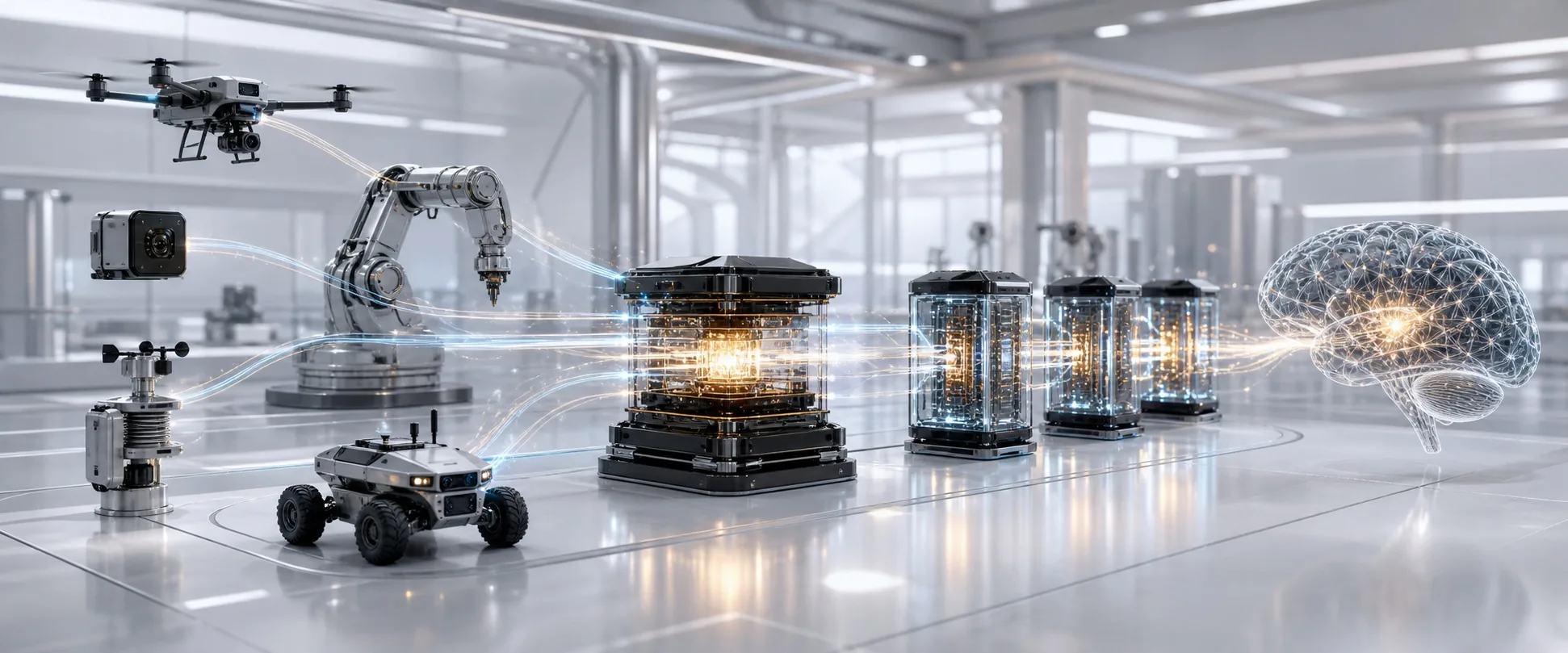
Multiple signal inputs enter the computing board from the left; five labeled structured outputs fan out to the right.
Site note: 'without delay' and 'immediate' express the original diagram's design intent, not a verified zero-latency guarantee. Processing time and supported inputs must be measured for the actual configuration.
We identify the products, technologies and next steps your field challenge requires. Where feasibility is unproven, we define what a PoC needs to measure.
In Japan, from October 1, 2026, all employers must implement employment-management measures to prevent customer harassment in the workplace.
Evaluate: consultation arrangements, fact-finding, appropriate recordkeeping and organizational procedures to prevent recurrence.
Explore response planning and PoCWe assess image quality as AI input in low light, night surveillance, ports, factories, equipment and mobile systems.
Evaluate: subject, illumination, distance, motion, lens and differences before and after AI recognition.
Review low-light camera evaluation conditionsWe consider closed-network, on-premises, Private AI and local-inference configurations around your data boundaries.
Evaluate: transfer permissions, latency, traffic, storage location and operational access rights.
Explore Edge AI configuration assessmentWe break down visual inspection, equipment monitoring, work records and knowledge transfer from image capture through operation.
Evaluate: whether defects can be captured and distinguished, and whether the process fits the production cycle.
Review manufacturing PoC decision criteriaWe organize the challenge, research theme, team, PoC, publicly disclosable IP and path to product development.
Evaluate: customer value, technical feasibility, required data, responsibilities and implementation rights.
Explore the path from collaborative R&D to deploymentWe assess your workloads to determine whether Edge AI is sufficient or a small AIDC is needed.
Evaluate: GPU demand, power, cooling, installation, availability and phased expansion.
Explore an initial AIDC assessment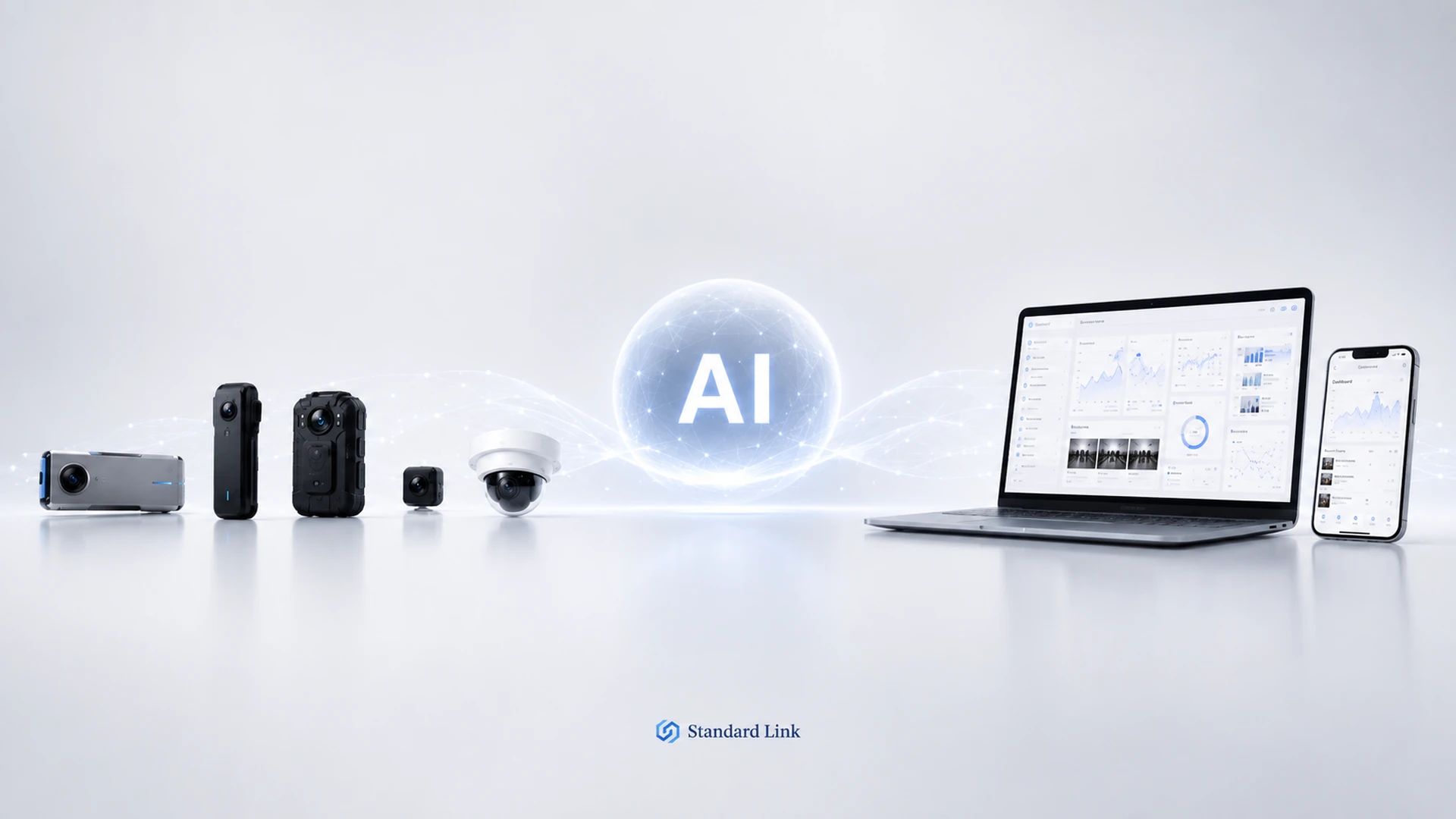
Cameras capture events, Edge AI assists in identifying candidate records, and records are preserved for people and organizations to establish the facts. As an initial Physical AI application, we introduce patented technology to protect employees (Japanese Patent No. 7728631) and contract development.
In Japan, preventive measures against customer harassment, including consultation and response arrangements, become mandatory for employers on October 1, 2026.
Explore the dedicated pageThese updates document progress across the layers of Physical AI, rather than isolated partnerships.
AI accuracy starts with its eyes.
From NVIDIA Jetson to Intel Edge: configuring AI vision and processing for each use case.


APPRO Photoelectron is listed in the Elite category of NVIDIA's official Jetson partner directory.
Standard Link has a strategic partnership with APPRO Photoelectron Inc. and has obtained exclusive distribution rights for its products in Japan.
Using APPRO's publicly documented camera and ISP technologies as configuration candidates, SLL defines the use case, connections, imaging conditions and evaluation approach. Each target device and SDK requires confirmation.
We are developing and evaluating multi-platform configurations that connect our proprietary IP with HOLONIC Edge AI.
APPRO Photoelectron is listed as Elite in NVIDIA's official Jetson partner directory. This status belongs to APPRO; it does not certify SLL, HE-1 or AIDC, or guarantee their compatibility.
Check NVIDIA's official listingSource: developer.nvidia.com
Image text translation
Reference translation prepared for this website. The source image is unchanged; this is not an original or certified translation.
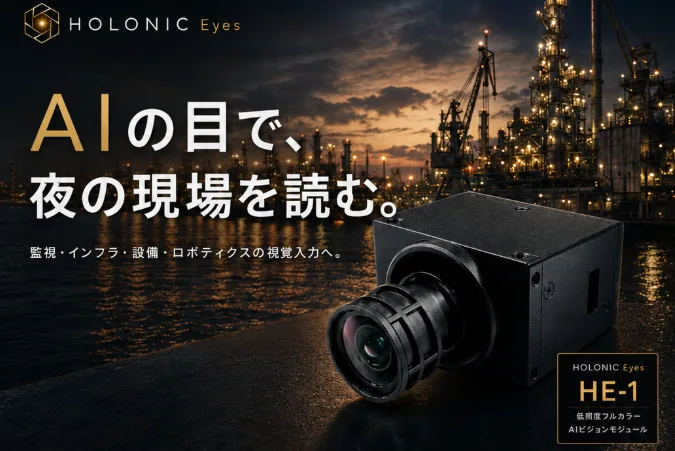
HOLONIC Eyes / HE-1
Read the night-time field through the eyes of AI.
Visual input for monitoring, infrastructure, equipment and robotics.
A camera product is shown against a night-time industrial setting; the lower-right label identifies HE-1 and its low-light full-color AI vision role.
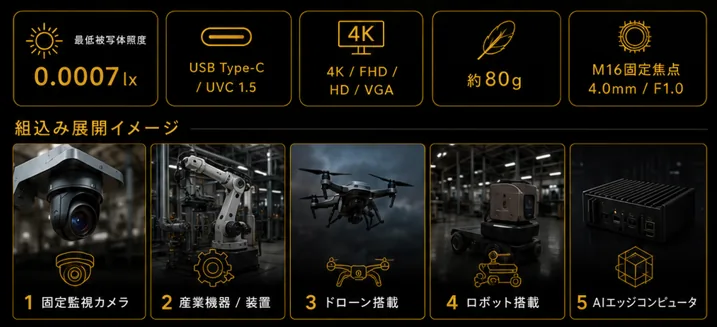
Image text translation
Reference translation prepared for this website. The source image is unchanged; this is not an original or certified translation.
Embedded deployment concepts
The five specification panels appear above five illustrated deployment options, numbered from left to right. The images show integration concepts rather than a compatibility guarantee for every depicted device.
Site note: 0.0007 lux is a reference value under our evaluation conditions. Lens, resolution, weight, interface and compatibility conditions must be confirmed for the proposed configuration; the figure does not establish AI recognition accuracy.
COMMERCIAL PROOF / AI EYE
PRODUCT / Evaluation and adoptionA vision sensor available for evaluation and PoC, capturing color in darkness and low light, with potential integration into fixed surveillance, industrial equipment, drones and robots. It supports connections to PCs and similar systems via USB UVC. NVIDIA Jetson configurations are evaluated for each device and environment.
Visual input to understand color, shape and field conditions at night and in low light.
A vision sensor for field operation, with integration into edge devices and mobile platforms in mind.
Applications in fixed surveillance, PTZ, drones, robots, vehicles and industrial equipment.

Image text translation
Reference translation prepared for this website. The source image is unchanged; this is not an original or certified translation.
Providing the eyes for Edge AI
HE-1 is an AI vision module designed to provide clear, full-color video even in low-light environments.
The concept supports AI's ability to see across robots, drones, equipment and infrastructure, enabling more advanced recognition, detection and decision-making.
A recognition network sits above the computing board, surrounded by camera, drone, robot and equipment icons. The visual links the vision input to multiple Edge AI applications.
Site note: these are intended applications. Image quality and AI performance require evaluation for each subject, lighting condition and target device.
Night monitoring, situational awareness and anomaly detection for ports, coasts and vessels.
Low-latency Edge AI processing for equipment monitoring, maintenance and safety checks.
Low-light monitoring, tracking and situational awareness using multiple sensors.
Vision and field AI for inspection, search and remote operation.
Input infrastructure that helps mobile systems perceive their surroundings and connect decisions to actions.
Continuous observation and analysis of fields, livestock, water quality, soil and environmental change.
Image quality and AI recognition accuracy are evaluated separately. Supply conditions, lead times and integration support are confirmed individually.
This design illustrates how field input and decisions connect to equipment or business outputs, with evaluation and improvement where needed. It does not indicate that all functions are complete or must be deployed together.
This concept rendering illustrates relationships between technology layers. It is not footage of hardware or evidence of a completed, validated system.
Starting with HOLONIC Eyes HE-1, we acquire high-quality field data from visible light and other sensors.
AVAILABLE NOWEdge AI and sensor fusion support local decisions while reducing latency and communication traffic.
PROJECT-SPECIFIC / Design and evaluationDrones, PTZ systems, robots, vehicles and industrial equipment provide the bodies for monitoring, tracking, inspection and control.
APPLICATION DEPLOYMENTAI processing is shared across device, site and regional layers to improve availability, safety and scalability.
INFRASTRUCTURE DEVELOPMENTData is stored securely and used for retraining, with improved models distributed back to field Edge AI.
PLATFORM VISION / Future conceptOptions include operation without transferring data outside the environment. Collection, learning and model distribution require customer agreement, permissions, defined purposes and safety checks. This does not mean automatic collection or unauthorized retraining.
R&D spans the whole system, covering problem definition, measurement, comparative evaluation and implementation decisions. Advisory input, research partners' assignments, SLL's project and technical responsibilities, and manufacturers' supply and technical support are distinct roles. Participation and scope are agreed with the parties concerned.
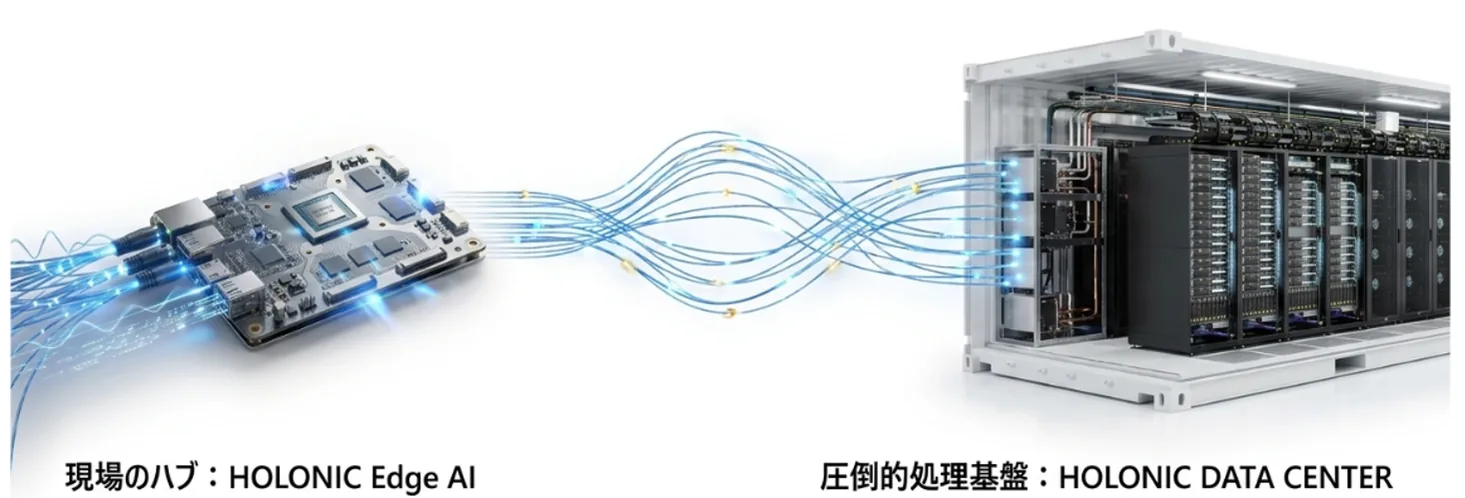
Image text translation
Reference translation prepared for this website. The source image is unchanged; this is not an original or certified translation.
On-site hub: HOLONIC Edge AI
High-capacity processing foundation: HOLONIC DATA CENTER
Multiple data paths connect the Edge AI board on the left with the containerized data center on the right, illustrating the relationship between on-site processing and centralized computing and learning.
Site note: the original uses an emphatic phrase for processing capacity. It is a conceptual description, not a substantiated comparative performance claim; capacity is determined for each configuration.
We introduce our granted patents, published applications and approach to their use. Markets, collaborative R&D, implementation rights and product-development conditions are considered together in technology and business design.
5 granted patents (including 1 jointly filed patent) and 1 published patent application. Other applications are in progress and will be listed after publication.The publication numbers for the 5 granted patents and 1 published application above can be checked in J-PlatPat.
Explore the IP frameworkHOLONIC Eyes HE-1 captures color in ultra-low light: an implemented visual entry point to Physical AI.
AVAILABLE NOWMillimeter-wave and environmental sensors complement conditions that cameras alone cannot capture.
PROJECT-SPECIFIC / Design and evaluationDifferent sensor streams are integrated over time to provide a more detailed understanding of field conditions.
PROJECT-SPECIFIC / Design and evaluationLocal recognition, selection and decisions process only the necessary information and controls with low latency and power use.
INFRASTRUCTURE DEVELOPMENTA proposed infrastructure for securely storing physical-world data and circulating it through learning, prediction and autonomous control.
PLATFORM VISION / Future conceptYes. We review your field challenge, available data, installation environment and decision deadline, then consider the appropriate approach using AI cameras, Edge AI, drones, small AIDC or collaborative R&D.
Yes. Start with the scope you need, such as an evaluation unit, product selection or integration. Not every project requires collaborative R&D or a PoC. Where feasibility conditions remain unconfirmed, we consider a minimally scoped evaluation.
We review transfer restrictions, permissions, storage and communications, then consider Edge AI, on-premises AI and closed-network configurations. Suitability is confirmed against the conditions of each project.
Yes. We define stopping criteria for value, technology, data and operational gates, keeping records that support decisions on further evaluation, redesign or stopping.
AI cameras, Edge AI, drones, robots, manufacturing AI and AIDC. Even without a chosen technology, we use your field challenge and measurable criteria to define the next decision.