Publicly documented
Products, granted patents, published applications, announced partnerships and published specifications.
Starting with publicly documented camera input, we evaluate on-site AI recognition and equipment control for each project. Mesh communications, distributed AI, and AIDC-based learning and model redistribution are identified as concepts and validated in stages, beginning with what the project needs.
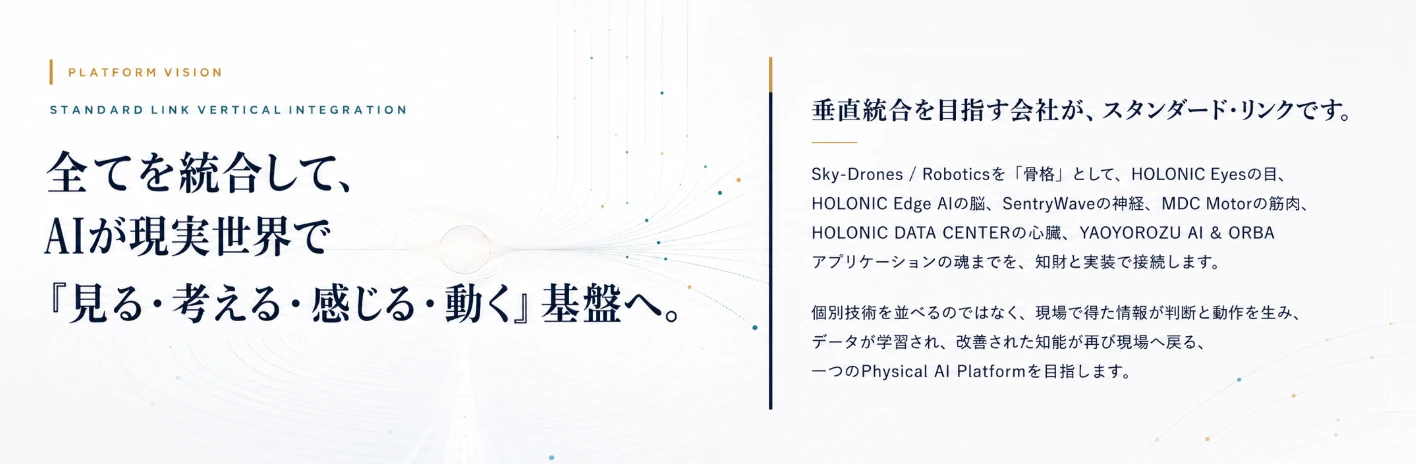
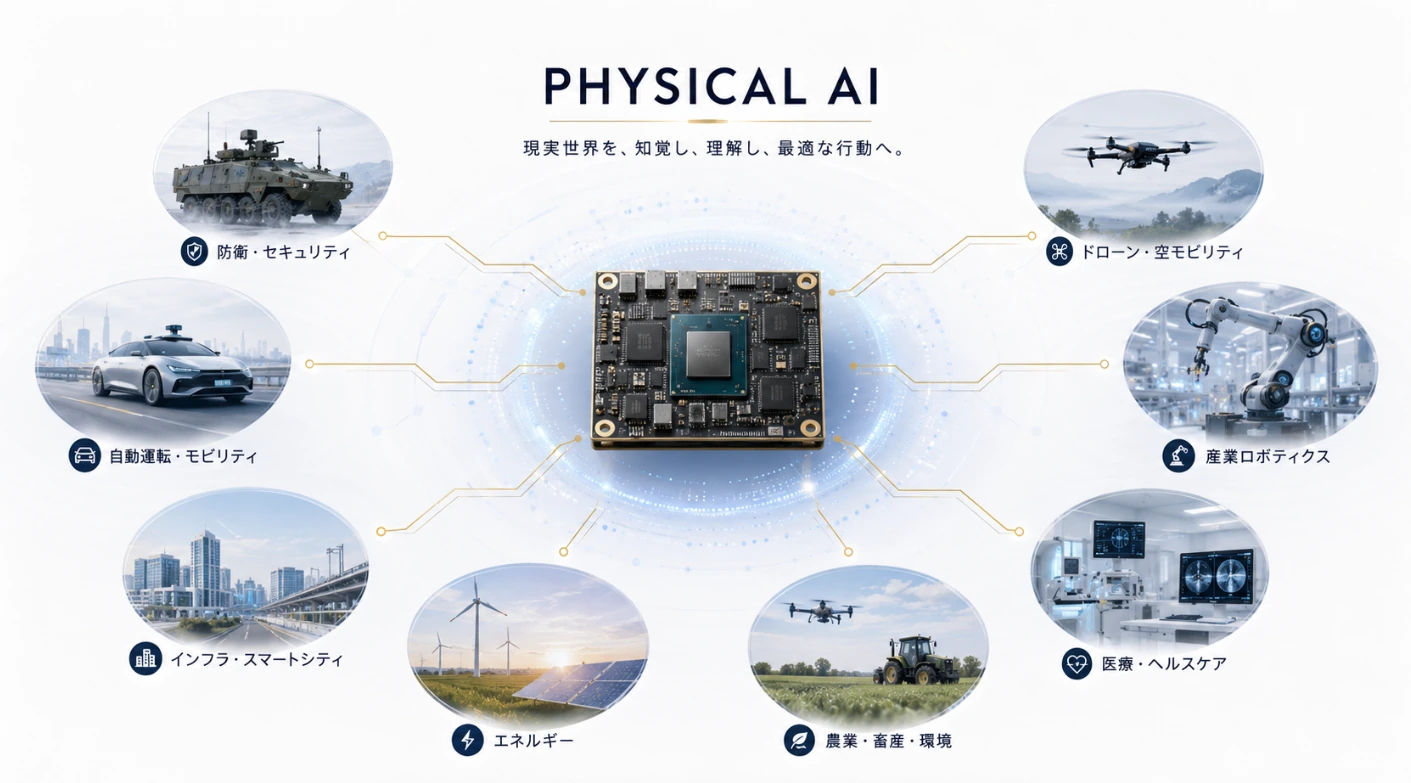
Standard Link is developing cameras, edge computers, drones, communications and distributed AI data infrastructure into a vertically integrated Physical AI architecture with intellectual property at its core.
We distinguish published facts and partner information from project-specific validation candidates and future concepts.
Products, granted patents, published applications, announced partnerships and published specifications.
Candidates whose targets, environments, interfaces, accuracy and operation require PoC validation.
Future directions are not described as available until implementation conditions and evidence are established.
Updated September 4, 2026. Evidence categories and test conditions are tracked in the V5 Evidence Register.
Define technology evaluation conditionsAPPRO Photoelectron is listed as Elite in NVIDIA's official Jetson partner directory. This status belongs to APPRO; it does not certify SLL, HE-1 or AIDC, or guarantee their compatibility.
APPRO's published manufacturer support, SLL's supply agreements, model-specific support for products such as HE-1, and our own validation are separate matters. We check the current contract scope and records for each model, OS or JetPack version and interface before defining supply, evaluation and maintenance responsibilities.
We supply camera, ISP and edge-imaging products from Taiwan-based APPRO, an NVIDIA Elite Partner, under our exclusive sales rights for the Japanese market.
We consider combinations with HOLONIC Edge AI and check camera-to-NVIDIA Jetson connectivity, supply scope and site conditions individually. Stock, evaluation-unit loans, Japanese-language technical support and supply traceability depend on each project's procurement requirements and service conditions.
NVIDIA Elite Partner status applies to APPRO. NVIDIA and Jetson are trademarks of NVIDIA Corporation.

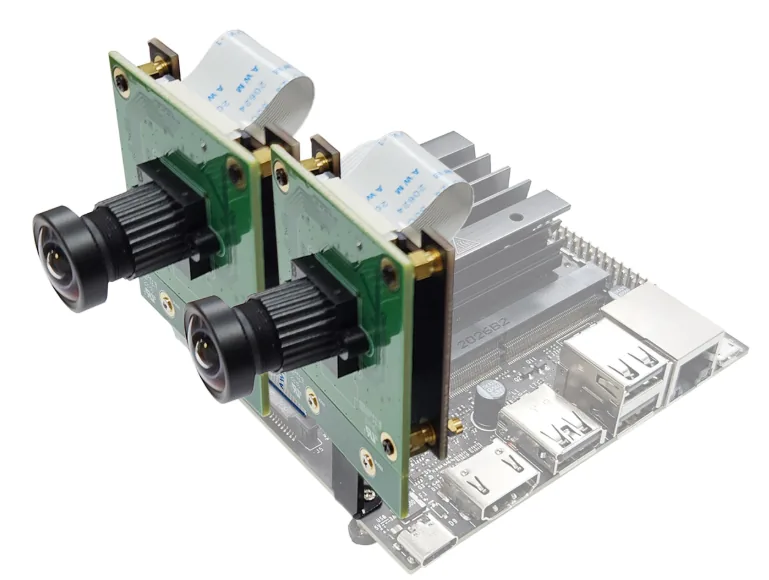
We consider APPRO's published Jetson camera and ISP technology as a configuration option. Connectivity is checked for each target device and SDK.
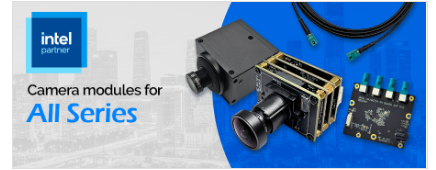
APPRO Photoelectron is listed as Elite in NVIDIA's official Jetson partner directory.
 HOLONIC Edge AI
RECOGNITION / DECISION / PHYSICAL AI INTEGRATION
AI eyes: visual input
AI brain: recognition and decisions
AI body: autonomous action
Distributed intelligence, learning and model updates
HOLONIC Edge AI / VISION & SENSOR EDGE
The integration method is determined after validating SDKs, operating systems, GPU / NPU, video input, power, weight and communications requirements. This does not mean that integration is already complete or that all interfaces have been verified as compatible.
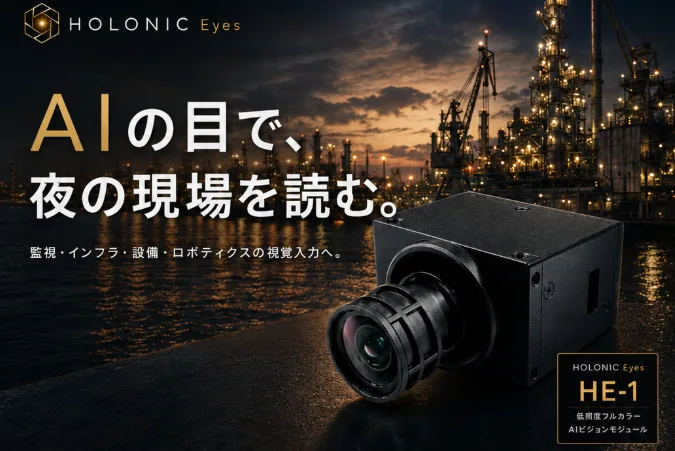
Image text translation
Reference translation prepared for this website. The source image is unchanged; this is not an original or certified translation.
HOLONIC Eyes / HE-1
Read the night-time field through the eyes of AI.
Visual input for monitoring, infrastructure, equipment and robotics.
A camera product is shown against a night-time industrial setting; the lower-right label identifies HE-1 and its low-light full-color AI vision role.
HOLONIC Eyes HE-1 is a high-sensitivity, low-light camera that captures color in night-time conditions where night-vision cameras are typically needed. As AI's eyes, it produces visual information for AI and serves as an Edge AI input device for fixed monitoring, PTZ systems, drones, robots, vehicles and industrial equipment.
Full-color night-time and low-light video capture with HE-1.
Object recognition, sensor fusion and integration with drone, robot and equipment control.
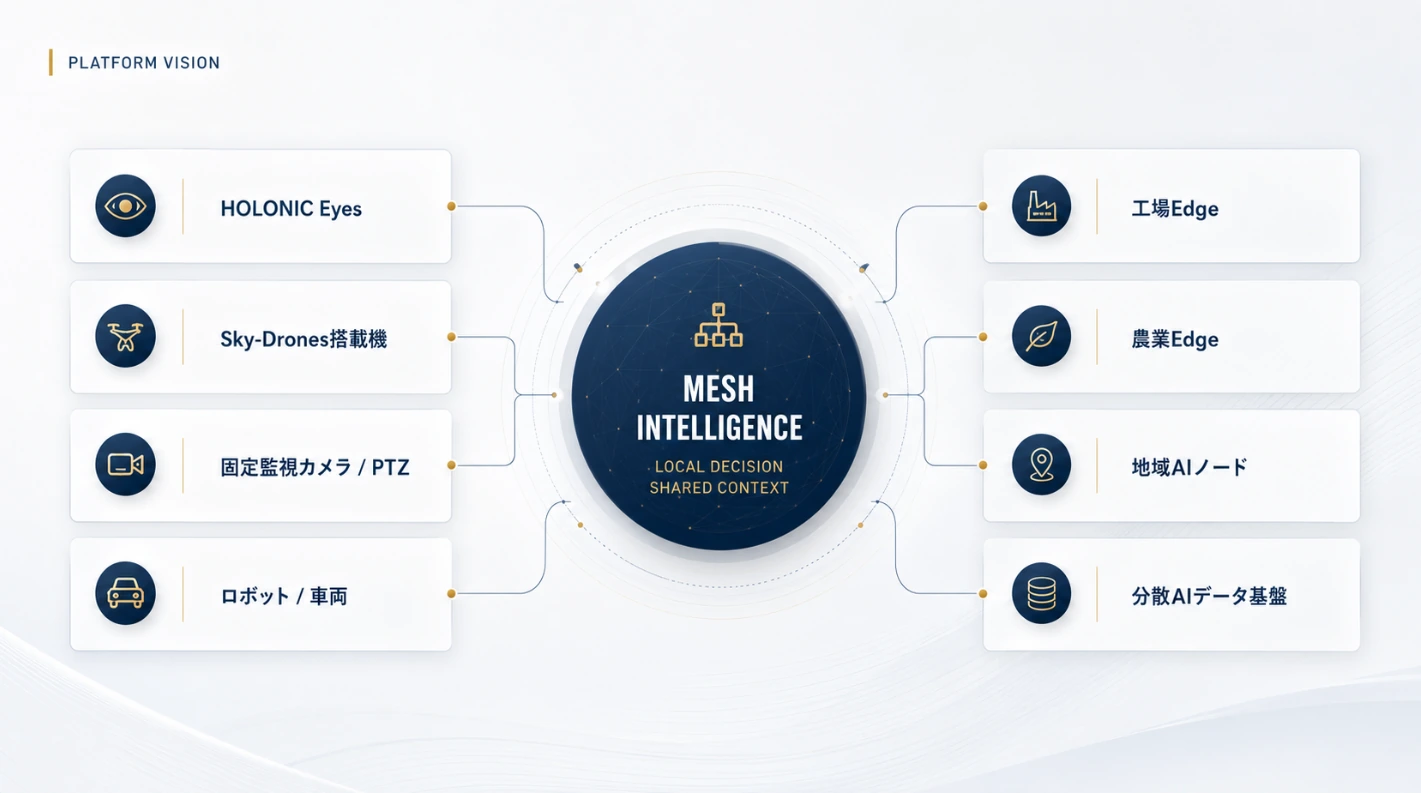
We are developing an autonomous distributed AI network that combines HOLONIC Edge AI and mesh communications to coordinate aircraft, cameras and sites.
Interpret visual input on site, share and learn from only the necessary data, and return improved models to the edge.
Use for learning, retention periods, anonymization and third-party sharing are governed by customer contracts and data governance. Customer data is not used unconditionally for our own model training.
Edge AI is both an AI processor and a gateway between the physical workplace and enterprise digital systems. Rather than simply storing video and sensor data, it converts them into usable events, states, anomalies, progress indicators and predictions.
Edge AI is the brain of Physical AI and a gateway to field-level digital transformation.
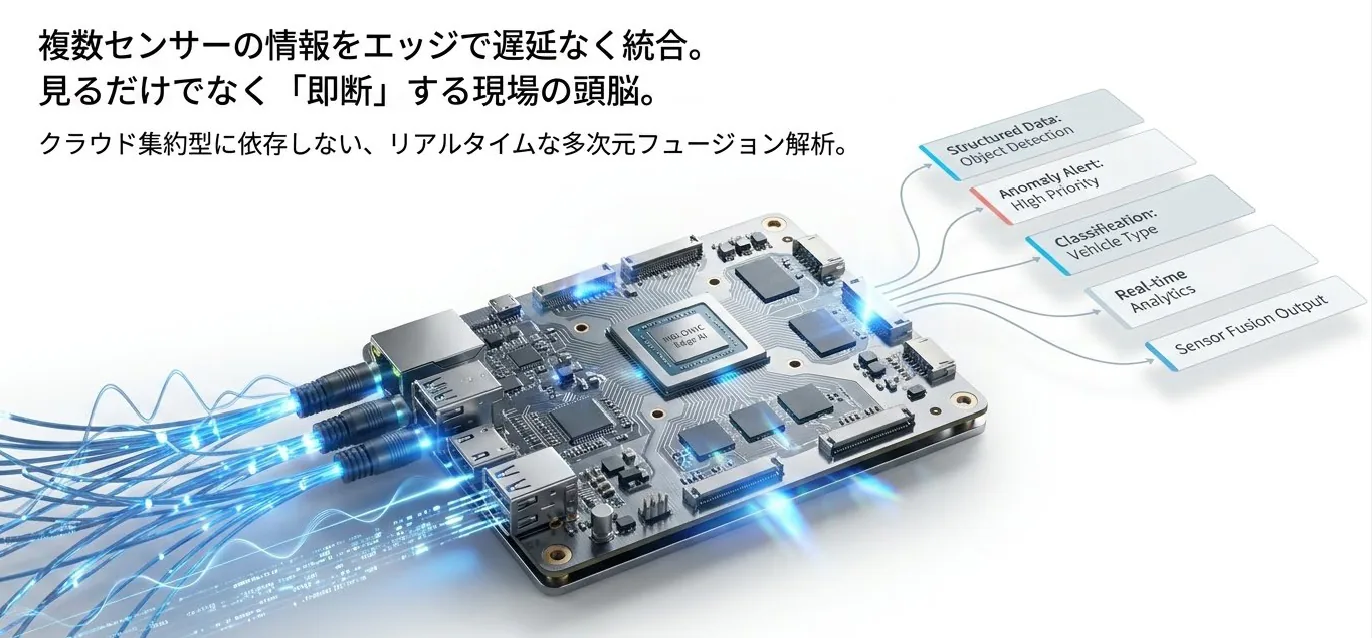
Image text translation
Reference translation prepared for this website. The source image is unchanged; this is not an original or certified translation.
The source concept describes integrating multiple sensor inputs at the edge without delay: an on-site brain that not only sees but makes immediate decisions.
Real-time, multidimensional fusion analysis without dependence on centralized cloud processing.
Multiple signal inputs enter the computing board from the left; five labeled structured outputs fan out to the right.
Site note: 'without delay' and 'immediate' express the original diagram's design intent, not a verified zero-latency guarantee. Processing time and supported inputs must be measured for the actual configuration.
These are examples of potential integrations and extensions, not standard integrations already completed. Implementation is determined after checking the site environment and existing systems.
IP supports every layer of distributed Physical AI.
Standard Link's IP is not limited to a single camera function. It supports the Physical AI processes of seeing, detecting, integrating, deciding, tracking, recording and learning across multiple technology layers.
Technology foundations based on published granted patents
One AI platform for different field environments.
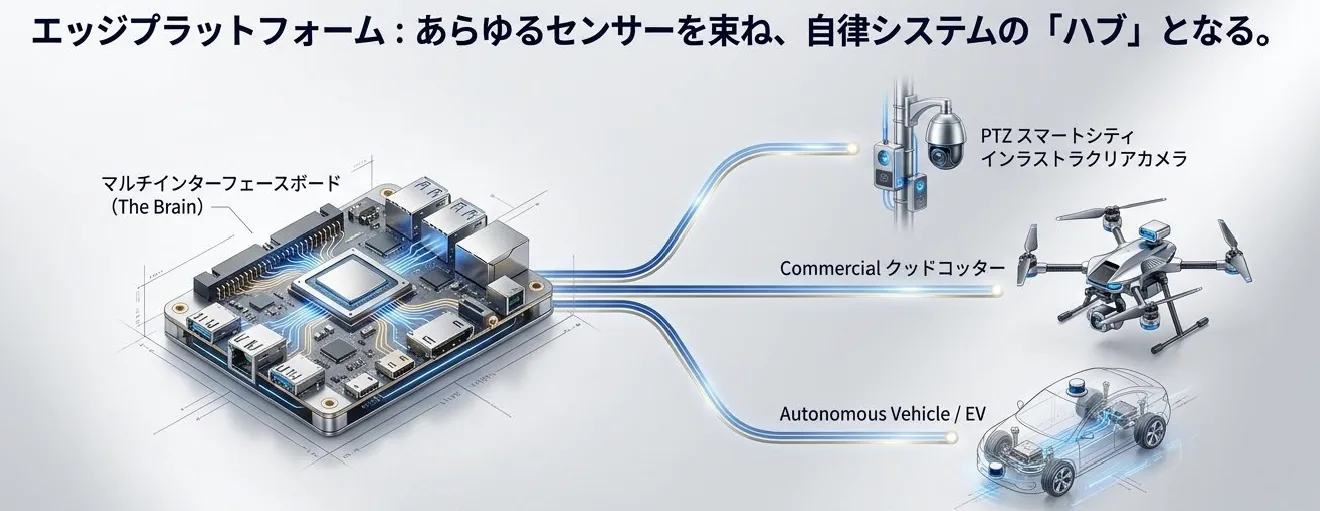
Image text translation
Reference translation prepared for this website. The source image is unchanged; this is not an original or certified translation.
Edge platform: bringing sensors together as the hub of an autonomous system.
Three signal paths fan out from the multi-interface board on the left to a PTZ camera, a quadcopter and a vehicle on the right. They illustrate possible platform integration paths.
Site note: the broad wording in the concept diagram does not guarantee compatibility with every sensor or device. Interfaces, target devices and operating conditions must be evaluated individually.
We connect technologies with different roles into an integrated solution without presenting each company's strengths as a single proprietary technology.
HOLONIC Eyes, HOLONIC Edge AI, mesh integration, distributed AI data infrastructure and IP architecture.
Japanese procurement mechanisms, including fast-track procurement and startup technology proposal evaluations for negotiated contracts, are developing to support companies with distinctive technology. Based on published contractual relationships and manufacturer materials, we check supply conditions, domestic support and procurement eligibility case by case. Contact us below to discuss specifications or request technical information.
Discuss the stage that fits your project: HOLONIC Eyes HE-1 evaluation, Edge AI, mesh networking or distributed AI data infrastructure.